Sunday, February 11, 2018

After the Visit: Reflections by Rebecca, Part II

The following was written by Madame Rebecca, who visited CAP February 2017 and November 2017 for a total of seven school days. An educator from NH, Mdm. Rebecca wrote these pages of reflection after her return to the U.S.

Part II
Christian Academy of Petit Goave, Haiti
Mission Statement 
Christian Academy of Petit Goave seeks the Lord's guidance to educate impoverished children in Biblical knowledge, life skills, and relationship building to create a rich school environment, supportive families, and unified community. 
Education:
To understand education in Haiti, it is necessary to recall what schools were like in America decades, or even centuries ago.  The methods of rote learning and recitation are reminiscent of late 19th and early 20th centuries.  A more accurate analogy might be what was fondly known as a ‘blab’ school in Colonial America.  A small group of children, under a school master or school ‘marm’ all recited their different lessons out loud at the same time.  Imagine the cacophony!  Then imagine a concrete building with 145 students all competing for a voice at the same time: now you can begin to appreciate Haitian schooling.
The spoken language of the Haitian people is Kreyol (Creole).  This owes it origins to the time before Haiti won its independence from France.  Initially a mix of French and African dialects, Creole was the language of the slaves, then of the populace which won its freedom.  This is the language that all Haitians learn at home.   Most books, including the simplest primers, are written and published in French, the language of education.  Most schools begin introducing English in the early grades.  For a student to complete their course of studies they must complete their equivalent of our high school, including two standardized, substantial government exams.  The percentage of students who finish is very small.  Earlier generations of parents, grandparents, etc. benefited from little schooling, and many are illiterate.  Parents universally desire something better for their children, and education is greatly valued.  Education is one answer to Haiti’s major issues.  If you are fortunate enough to complete the final government exams, (and many study and take these tests repeatedly), there are opportunities to attend university.  Some universities begin the higher level courses immediately, because if you have mastered the earlier exams, these are comparable to our first two years of college.  Higher education, equivalent to a graduate degree is very difficult to come by within the country, and usually students must go abroad to further their training.
At the school in Petit Goave, children begin at age three, (or turn three during the year).  This is typical of many Haitian schools.  Unlike preschool programs here, the children wear uniforms, sit in chairs or on benches, and write with pencils and recite information.  Play is unknown.  From a young age children are conflicted with the opposite pulls of conformity to rules and teacher direction, and the need to stand out and receive attention and recognition.  Misbehavior is not tolerated in Haitian schools, punishment is generally swift and severe, and can result in permanent expulsion.  But yelling louder than anyone else, and striving to be the best and first is reflected in the pervasive competitive spirit.  At least in the school in Ti Goave, the children are not quiet, despite the teachers’ constant call for silence.  When a child knows the answer, or wants to be acknowledged, they raise their hands, wave their hands, or leap out of their seats.  They also verbally yell out “Me!  Me!” or they yell the answer itself; another disturbing manifestation of noise.
Many public schools in Haiti are held under roofed structures, with or without walls, with dirt floors.  Others are of concrete construction, but are small, dark, and with no amenities.  Private schools abound, some cater to the few wealthier familiesand have electricity, running water, and some technology resources; but many mimic the primitive public schools.  Some private schools are funded by non-governmental organizations (NGOs), receiving donations of money, materials, and services from the United States and other nations.  Teachers at many of the schools have received some training, but not a lot.  They teach in the same style they were taught, and are resistant to change.  Sometimes teachers are hired who have not completed their government exams, but they are considered to have enough education to be able to teach others.  Training on subjects like classroom management, using materials, dealing with social or emotional issues are not available.  Teaching the basics for reading and mathematics is occasionally supplemented with writing (grammar), languages, and some science and history, but extracurricular activities, the arts, and even physical activity are unknown.
 Everything is memorized by rote repetition and study, and students are examined orally or on paper only to assess whether or not the concept has been memorized, not understood or reasoned.  Second graders may be able to recite addition facts, but they don’t know that they have ten fingers and that constancy of numbers doesn’t change.  Preschool students learn to recite the alphabet in three languages, but don’t necessarily know the sound the letters make, or how to put them together.  They learn to rote spell, but don’t apply it in their writing in French or in English.  (The constant need to switch languages does not help master concepts.) 
In most schools students are punished for not ‘knowing’ their lessons.  This includes public shaming, and corporal punishment.  Over time if a child cannot keep up with the curriculum they may receive poor grades, may be retained another year, and if they don’t show improvement in their progress, they are ultimately no longer welcome to attend school.  Remember that all students have to pay for their education and because schools are desperate for money and resources, they accept more students than they can accommodate, and so if children fade in and out of a class, no one really follows through.  Any student who cannot access the curriculum in the one size fits all style of teaching is simply ignored or passed over.  They are labeled as those ‘without intelligence’, and it is not possible to extend the effort to really reach these who ‘cannot learn’.
I am happy to report that the Mission school in Petit Goave differs from the typical model in several important ways.  The school is funded privately by donations from people in the United States; this includes the rent for the building, paying the salaries for the teachers, providing the books and uniforms for the students, the enriched rice and bean lunch, basic health care, and many donated supplies.  Each spring parents come in to register their soon to be three year olds for the incoming class in September.  Last February over one hundred applications were filled out over a two day period.  Only 25 slots were available so more than 20 of the students were chosen by drawing names in a lottery system.  Many heartbroken parents pleaded for the director to reconsider, citing such valid reasons as already having a sibling in the school, or having no other avenue to pursue for their child’s education.  In other schools they may have accepted a larger number of students, but part of the philosophy of this school is that it is not feasible or desirable to have a class with one teacher and more than 30 students.

Some of the children accepted are invited deliberately because their unique conditions are known to the staff.  These students are some who would never have an opportunity to attend a typical Haitian school.  They are children with low cognition, with health problems, or other challenging needs that just simply could not be addressed in another environment.  These students, including a girl with Down syndrome, another girl with severe asthma, a little boy who doesn’t speak, by no means receive the services they deserve, because the resources don’t exist.  However, the miraculous fact that they are allowed to attend at all speaks well of this special school.
There is no corporal punishment at Christian Academy.  Children are not punished for not knowing their lessons.  As much as possible the teachers try to reteach and allow another opportunity to try.  A child who is significantly behind academically is retained in the same class for a second year.  Currently there are a few students who have been retained but are not making the necessary gains.  It is unknown at this time what will happen with them next year.  (It is common for much older students to be found in primary classes, because when they were younger they had no opportunity for school, but now have a chance.  The young man who serves as the custodian in the mornings, goes to fourth grade in the afternoons.  He is 17.)
Misbehavior is treatedwith a different philosophy as well.  Children are sent to the office where an administrator speaks with each of them individually.  Often the children are asked to copy lines such as:  ‘I will obey my teacher.’ Or ‘I will be respectful during assembly.’  Frequent offenders or more serious infractions include parent contact, and possibly a conference.  Depending on the situation the director may recommend that the parents administer some form of corporal punishment. The philosophy is that sometimes a child needs this type of correction, but it must be done appropriately, in love, and in the child’s best interest.  Part of the process at the school is to remind students not only what the teacher and school expectations are, but also what God desires for them to do and be.  It is constantly reiterated that the children are loved and that the staff desires them to be there and wants them to grow and learn.  It is also understood that if a child or a family is unable or unwilling to change, other students are waiting for the chance to come to school.
School Motto: recited weekly

Discipline: students are copying the School Motto in the office


There are many disturbing issues about the school, and it is hard to reconcile an American mindset with the real world problems in Haiti.  I was told that the three and four year olds don’t know how to play.  The three year olds have a few toys in their classroom, and have a small amount of time scheduled in their day to use these materials at their seats.  The four and five year olds do not have toys or playtime.  While there I went into the three and four year old classes a few times with a small bag of toys, and passed out one item to each child.  What I observed was typical of what you would see with babies and toddlers here.  The children were eager to receive a toy, but they banged it, or they took two and banged them together.  They also grabbed the toys the other children had, because of course, the grass is always greener.  After a while they figured out how to drive the little cars along the table, and even to speed them off the table.  I modeled how to roll the balls to each other, make the little plastic animals walk and hop, and cradled the baby dolls and stuffed animals.  But after a very short time I had to remove the toys because their exuberance was overwhelming and they quickly became over stimulated.  Truly, they do not know how to play.

Reading The Twelves Days of Christmas to first grade

Many teaching materials have been donated, which would be valuable for providing concrete learning of concepts, especially in math.  The teachers have no experience with these items and have not yet been shown how to use them, so they are currently sitting in a locked room on the second floor of the school.  Teachers need to be trained and given opportunity to utilize the simplest tools, so that they in turn can teach the children.  The director shared my frustration in not being able to introduce the items, but she also respects that the wheels of change turn very slowly, and staff need to be given time to adjust their mindsets.
One particularly disturbing thing is that children are not being taught to think.  They do not reason or problem- solve, or apply or discover or explain anything.  (Except perhaps to try and justify the reasons for their bad behavior.)  Haiti has a history written in blood and poverty, exploitation, military occupation, and debt.  The once beautiful Pearl of the Caribbean has been deforested and stripped of its natural resources.  Natural disasters like the yearly hurricane season, and the devastating earthquake of 2010 perpetually leave them reeling.  Aid pours into the country but corruption and mismanagement prevail and goods and services fail to reach those who need them.  Malaria, and other mosquito borne illnesses, typhoid, cholera, severe anemia and malnutrition plague the nation.  Promises of better government services dissolve until the next white knight appears on the horizon.    Desperate people commit desperate acts, and the streets resound with manifestations and violence.  Children, the future adults, must learn how to reason and assess things critically.  They need the hope that education provides, but they need a better education, a different from that they are currently receiving.  Facts can be memorized, and everyone can acquire some level of speaking in multiple languages, but unless they learn how to apply principles, and utilize talent, unless they are given opportunity to rise above the teeming masses of humanity, they will not succeed as a nation.  Competition is fierce and only the best and brightest, or most assertive or persistent survive.
Having said all this, and it is unquestionably true on many levels, one cannot ignore the profound hope and joy that the people possess.  For anyone who lives in a ‘first world’ country, it is almost impossible to comprehend the ability to maintain ‘optimism’ and to endeavor to work hard even when there is little or no monetary reward.  How do they not give in to hopelessness and despair?  But, many Haitians will tell you that there is much reason to hope.  “Gen espwa anpil.”  For some it is the hope of education, it is the dream and desire that Haiti can regain the beauty and prosperity she once experienced.  The majority of people want to be engaged in labor and feel productive.  They take pride in their accomplishments, even when those accomplishments may seem small and even insignificant to us.  Some still put their hope in local and national government.  They are appreciative of all the aid that has poured into their country, and recognize that without international help, Haiti would not have even the minimal amenities they have; while at the same time they desire Haiti to function as an independent nation directed by its own people.  But one must look beyond these surface reasons, and indeed many are fully ready to ‘give an answer to the hope that lies within’.  To them it is not a mystery, to them it is obvious:  Jesus.
Living in such incomprehensible poverty, doing without so many things we take for granted, they are truly grateful for the very breath that sustains them, for their daily bread.  In a culture where starvation is a reality, the threat of malnutrition a constant companion, and anemia the norm, they are thankful for the daily meal of rice and beans.  Monotonous?  Yes!  But able to sustain life, yes.  Though there are physical hands that prepare the food, and a physical locality where the food is stored, and real people who donate their funds and resources to provide it, the impetus, the driving force behind the generosity is a benevolent God.  God is the one who places the desire to help on the hearts of those who are able to help.  God is the One Who gives and preserves life.  Over and over the people are willing to share their miraculous stories, of how God has provided.
How does this impact the educational aspect?  Every person who comes into the building is greeted with the words “Jezi renmen ou.”  (Jesus loves you.)  Every person is also greeted with the words “I love you.”  The staff is composed of normal people.  They are not super spiritual, they don’t have misperceptions of reality, and they don’t always feel loving and kind every single moment.  Every person instead recognizes that life is hard, but God is good.  They recognize that on their own they do not have the ability to love and care for one another.  Everything is dependent upon the God they serve, upon the Savior Who first loved them, and Who left the glory and splendor and riches of heaven, and Who lived in poverty, and died to redeem mankind from the broken fallen world of sin.  Every morning, before the children are formally greeted in the courtyard the staff meets to share songs of praise, verses of Scripture, and prayer for the needs of the school and their individual families.  Then each teacher greets every other teacher with a hug and kiss and words of affirmation and faith.
The Christian Academy of Petit Goave wants to educate children in fundamental academics.  They want to nourish little bodies, ensuring that they have food, clean water and basic medical care.  They want to encourage families, and model how to nurture and care for the children.  They want to show children how to get along and be kind; to be responsible and hard working.  But most of all they want to share the love of Jesus, and to imbue in every child the truth that their hope, their only hope lies in the Person of Christ.  Teaching reading and math, and doling out vitamins and cold medicine are important.  Holding students accountable for their actions is vital.  Preparing them for a future of higher education or trade is laying a firm foundation.  But the ultimate goal, the ‘mission’ is to share the love of Jesus.

What Can We Offer?  What Can We Emulate?
What can we offer?  Haiti needs goods and supplies.  The schools need materials, and the teachers need mentoring and training to utilize the donated items.  They need encouragement to continue on the incredibly arduous task they have undertaken.  The staff and the children are uplifted when teams and individuals make personal sacrifices to come and spend time at the school.  Students need people to partner with them and commit to monthly support, not only for monetary needs, but for emotional support.  The idea that someone who lives far away has purposed to set aside resources to benefit and love them as unique and special, is a gift that can never be matched.  In many aspects of education Haiti needs to be brought into the 20th century, then the 21st.  Creating a truly free public system for every student is the goal, but it is light years away.  Providing a place where every child can come and be cared for and trained in the most fundamental academics is a first step.  Teachers need to be assured that they will be compensated for their job.  Most of the teachers have families to care for, and they sacrifice many hours to teach other peoples’ children.  They do this for an incredibly small amount of money.  One primary teacher we met earns the equivalent of $35.00 American a month.  The public educators periodically go on strike because they do not receive any wages from the government for weeks or even months at a time.  High school age students hold manifestations in the street to protest the absence of their professors.  The professors strike, because they have not been paid.  These are mountainous issues which people from outside the country, no matter how well meaning, simply cannot fix.  Our challenge is to look at the smaller, more manageable pieces where we can make a difference.
What can we emulate?
At the Christian Academy of Petit Goave teachers set aside time every morning to meet together and encourage one another.  They recognize that in order to serve others, they need to make sure that they are renewed and refreshed every day.  They value each other and they value every child who comes through the door.  This is a lesson I think we can benefit from.  Of course we do not all share the same philosophies and world views.  Our schools are larger with many more staff and children.  Our problems are different.  Somehow though, I would like to think that it is always possible to encourage one another more consistently, and to show empathy and compassion to each other and to our students and their families.  Yes, there are days when this is very hard and we don’t feel like doing it.  For me personally I want to be reminded of the unimaginable obstacles that are normal for those living in Haiti.  Surely if they can persevere and remain positive, I should be able to do that.  I should not become so easily discouraged in well doing, and not complain about the frustrating circumstances I face.  If nothing else, I need to recall to mind the hope, the dignity, and the honorable choices displayed by the staff at this special school.  They are truly an inspiration.
Going to the Library with Third Grade


A very big Thank You and Merci Beaucoup, Mesi Anpil to Mister David and Madame Rebecca for their hard work on the ground at CAP, and their ceaseless energetic support of CAP and Beverly and Rachelle. Thank you for sharing your words and wisdom with us here on Ramblings, Mom. 

After the Visit: Reflections by Rebecca, Part I


The following was written by Madame Rebecca, who visited CAP February 2017 and November 2017 for a total of seven school days. An educator from NH, Mdm. Rebecca wrote these pages of reflection after her return to the U.S.

Part I
Christian Academy of Petit Goave, Haiti
Mission Statement 
Christian Academy of Petit Goave seeks the Lord's guidance to educate impoverished children in Biblical knowledge, life skills, and relationship building to create a rich school environment, supportive families, and unified community.

Physical features of the building:
  The National Road which connects Port-au-Prince with the western portion of the island passes in front of the building.  There is just enough space to pull in the vehicle from the house to park close to the metal gate manned by the hired guard.  (Unlike many places in Haiti, he is not armed with an automatic weapon.  Tall cement walls, topped with barbed wire and broken glass encircle the building.  The gate opens onto a small dirt floored courtyard, littered with building materials on the side.  There is just enough space for the six classes to line up side by side facing the building.  An exterior staircase ascends to a portion of the second story which is rented by a training clinic for nurses.  The children gather in the courtyard and wait for the teachers to be ready to sing and pledge to the flag and begin the day.
As they step over the high threshold, children proceed into the concrete building to their classrooms.  A bench sits along the left wall and it is here that children gather for triage, or if they have been pulled out of line for disciplinary action.  Along the left side of the corridor are four rooms.  The first two, grade one and kindergarten have been painted and contained louvered cement block windows.  Banana trees grow right up to the building and block most of the light.  The building has no electricity.  First graders have desks and benches which seat three to four students each, and kindergarten has long tables and individual low chairs.  Each room has a chalkboard, a bookshelf, a small table on which rests the water supply, and a table and chair for the teacher.  Each room has two doorways, with no doors.  The second two rooms are for grade three and recreation and were not painted until this January.    The recreation/assembly room is empty except for one small bench. 
On the right side are two rooms for the three and four year olds.  Each has a plywood door which can close.  The furniture is the same as for kindergarten.  The rooms are smaller, but brighter because of the natural light.  In the three year old room there is a basket with a few toys.  A small office, with a private toilet for staff, has a door which locks.  Records, medical supplies, and extra consumable supplies are in this room.  It is used for medical treatment, and discipline.  Following down to the end of the dark corridor is a two stall bathroom for students.  Outside is a table with room temperature water for hand washing, and strong soap.  There is no way to dry hands.  A large barrel of water sits at the bottom of the indoor staircase.  Jonas, the day custodian periodically uses the bucket from under the hand washing station to force flush the toilets, then refills the washing bucket.
Going up the cement stairs, which turn once, you ascend to the portion of the second floor which the school also rents.  Here is a small kitchen, with a counter for the two tubs of water for washing and rinsing the tin plates and spoons.  A table is for the pots of rice and beans which are cooked at the house and then transported to the school to begin serving at 10:00 am.  Earlier in the morning Jonas prepares peanut butter crackers and takes a plate to each class for a snack.  Another large barrel is used for filling the wash basins.  Detergent goes in the wash water and bleach is added to the rinse water.
The second grade classroom is located on this floor and though the furnishings are the same as first and second grade, this room receives more light and in addition to paint on the walls, they have also been stenciled in a bright design.  One small locked room contains shelves of donated books and some resources for teaching which are not yet in use.
Everything is constructed from concrete and there is nothing to absorb the sound.  Only the three and four year old classrooms have doors.  The Haitian style of teaching is rote repetition in loud voices.  The noise is relentless and inescapable.  The room used for recreation allows each class to come in for some physical activity while they practice academics and English.  Here is the only time the children get to run around (a dark concrete room), and the noise level is commensurate.  Additionally is the constant noise from the flow of traffic and pedestrians outside the gate.
There is only natural illumination, and recently a couple of rechargeable battery operated lanterns for the darkest rooms (kindergarten and third) to augment the limited light.  The property next door is owned by someone else so the landlord cannot cut down the vegetation blocking the light.  The green chalkboards are almost impossible to read from the back of the classroom.  The children write with pencil on tiny lined notebooks that absorb the humidity, and even the graphite is hard to decipher.  Obviously, there are no technological devices of any kind.
If you stand in the hall you may be fortunate enough to catch a breeze coming from the courtyard, but there is no ventilation anywhere else.  Even in November, it is hot and humid.  Many bodies in small spaces raise the temperature.  Here is one reason to be thankful for the concrete.  School begins at 8:30 a.m.  Three, four, and five year olds are dismissed at one and the older students at two.  By the afternoon everyone is wilting in the heat.
As the day progresses the stench from the bathrooms (two toilets for 145 students) becomes unbearable.  It is necessary to hold your breath when you go up the stairs.  By 9:30 the floor is soaked with water from hand washing and force flushing. The children and staff walk through it all day, adding mud to the concrete floors.  A night custodian comes daily to clean.
Many schools in Haiti are simple roofed structures with open wall, which is why school is cancelled nearly every time it rains.  Nicer, expensive private schools have more amenities.  Most schools require uniforms and books, which parents must pay for. 

Health:
Children receive peanut butter crackers in the morning and fortified rice and beans (Manna packs from Feed My Starving Children) for lunch.  (Extra nutrients have been added, and occasionally the person cooking adds a few canned vegetables.)  Children and are given oral vitamins with iron daily.  Children and staff are given worm medicine every six months.  Some children do eat something at home before they come, many do not.  Some bring pre-packaged snacks from the vendors which line the streets, most do not.
In each classroom is a double bucket with lid.  Water is poured into the top bucket which contains a charcoal filter.  Water flows into the bottom bucket with a spigot for filling water bottles.  Each child has been given a water bottle, but a supply of pre-used juice bottles is kept in the office when they need a replacement.  The children are encouraged to drink water frequently, as their supply at home may not be as sanitary and it is a hot climate where much body fluid is lost through perspiration.
The vast majority of the children come to school scrubbed clean.  They wear their uniforms Monday through Thursday, and are allowed to wear other clothing on Friday.  The uniforms may or may not get washed during the week.  The school ensures that children are provided with clean socks and shoes if they do not have them.  In a culture where almost everything is outside of one’s control, they take pride in their personal appearance.  (I was astonished to see little girls coming on Friday in spotless frilly dresses. (Lye soap and sunshine is the key.)  Of course some children come disheveled, and uncared for, but the majority is more than presentable.
In the morning when the children enter school, any who are sick wait on the bench to be summoned to the office.  This may involve a teaspoon of cold medicine, a dose of acetaminophen, cream for head fungus or ring worm, or wound care.  Serious illnesses are taken by the director to the local hospital, where you pay up front before any treatment is given.
When I visited in February, many children were suffering from grippe(cold symptoms).  I was given a bottle of cold medicine and a handful of metal spoons.  Depending on the age and weight of the child I dispensed liquid accordingly.  When finished each child took the used spoon to the kitchen to be washed in bleach water.  During the November trip I was much busier with medical concerns.  Many of the little boys suffer from head fungus.  They wear their hair very short, or completely shaved.  The boys line up and with one gloved hand for all of them, ointment is applied to each spot.  One child had a severe case and was taken to the hospital.  Infection was discovered and he was given an antibiotic.  Unfortunately he took it at home on an empty stomach the next day and vomited it all over the floor of the office at school.  (The good thing about it was that the office is the only room with a tile floor which makes cleaning much easier.)  The several cases of ring worm were treated with the same topical ointment.
On different days I had little girls coming to school with very high temperatures.  (102 and 103)  These I treated with acetaminophen, and sent back to class.  One girl, who was too ill to return to her studies, stayed in the office, lying on the hard wooden bench.  I sponged her down with water, and she eventually went to the hospital because we learned from her mother, who is on staff, that she had not been eating.
Any child taken to the hospital is tested for parasites (requiring a stool sample), anemia (because they have virtually no iron in their diet) and are given vitamin C.  After those things are checked, they look at the symptoms.  The child with the fever and the boy with the severe head fungus were both found to have intestinal parasites, though everyone was dosed with worm medicine in October.  The little girl who had not been eating was prescribed vitamin C and an appetite stimulant.  None of the three students were anemic enough to warrant attention.
Wound care is another ongoing task.  The normal bumps and bruises of children are virtually ignored in Haiti; they are simply not serious enough to deserve notice.  More serious wounds from cuts, scrapes, or burns are tended to.  (Because most of the children live in hazardous environments, and because many of them travel to school on motos, (motorcycles with long seats that carry a driver and up to five students) and because everyone cooks over charcoal fires, wounds are common.  One boy had a partially healed burn on his leg which I washed, treated and bandaged.  The wound had begun to close without getting rid of the inner infection, it had not been stitched and the scar will be significant.  He was taken to the hospital and the director was at first told that he would receive a surgical procedure.  Though the wound should have been opened and drained, it was just washed and covered with a single band-aid.  His treatment at school was better.  This child barely flinched while I was treating his leg; many children in Haiti have learned to tolerate pain because so little medical attention is available.  Another boy, however, reacted as most seven year olds would.  His wound had scabbed over and then was scraped off.  I cleaned and bandaged it, while he cried, but the second day it was full of green pus.  He was afraid to have me treat it again, but the director chided him for his understandable reaction.  The children have to learn to be tough!  Fortunately on my last day there, the leg was looking better.
I visited a local pharmacy while there.  It is a typical, tiny store.  You step in and immediately in front of you is a long counter, glassed in, with a window to pass things through.  On display behind glass is over the counter remedies, and the pharmacist hands everything from the inventory in the back.  I don’t know what happens if the medicine is not in stock.  One day we went to fill prescriptions for a sick baby we had visited.  The mother had taken the baby to the hospital where it was evaluated, but the family did not have money to pay for medicine.  The doctor wanted it treated with acetaminophen for fever.  The house and the school have a donated quantity of this, but not the infant dose, so we purchased this.  The hospital recommended pedialyte for the dehydration and diarrhea, but this electrolyte isn’t available in the town.  It can be purchased in Port-au-Prince, but it is very expensive.  We bought Gatorade to give to the baby.  We did fill a prescription for an antibiotic.

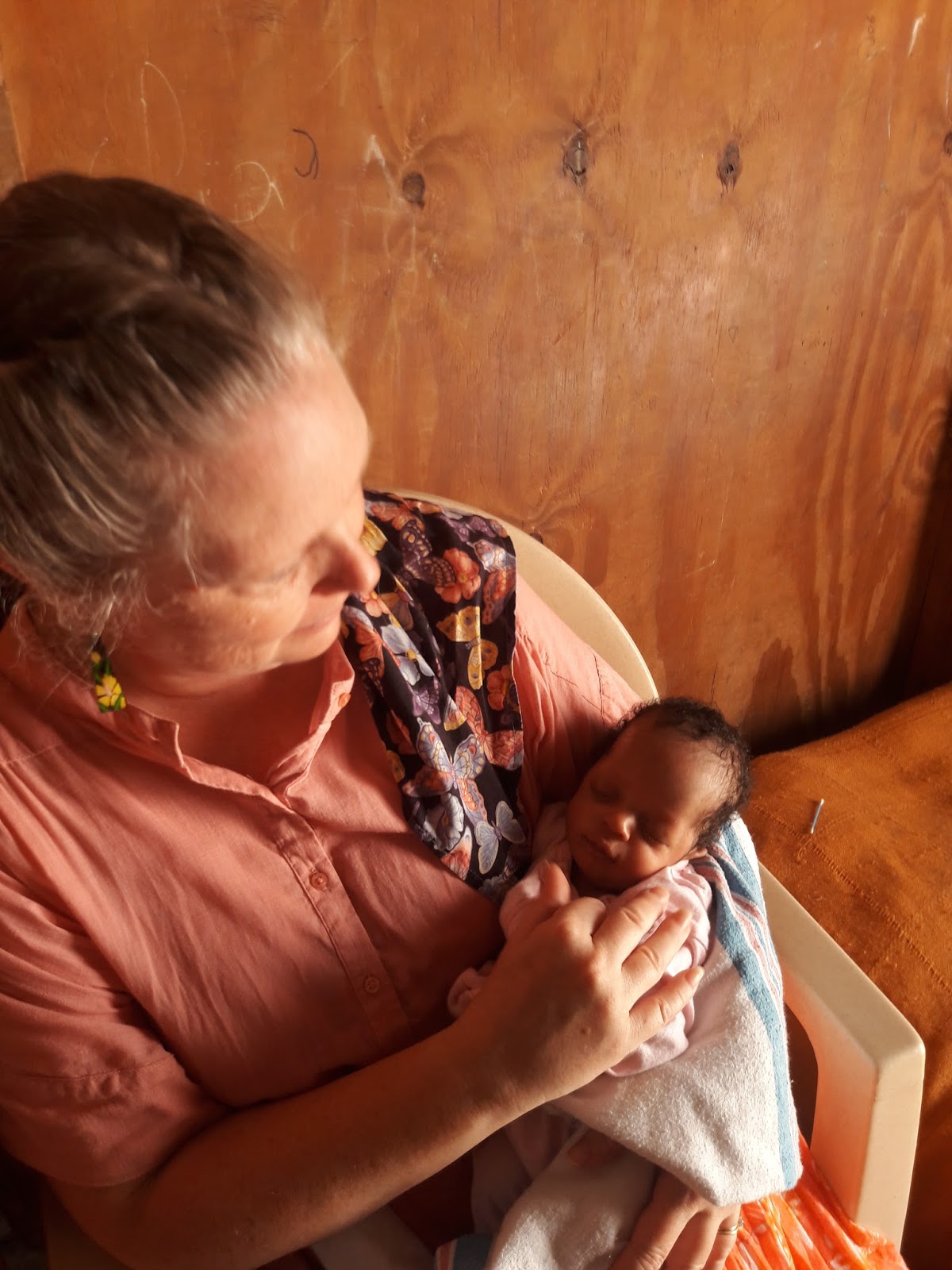
Mdm Rebecca with one of the triplets

Recording height and weight of four year old students

Another family we visited has one month old triplets!  The previous week the family asked for assistance because the babies were losing weight.  Through connections the director was able to procure cases of free formula to supplement the mother’s breast milk.  Another connection in a close town will be providing care and supplemental food and nutrition for the mother and the babies every other week.  The director will pick them up and transport them.
Students at the school each have enrollment information, a copy of their birth certificate, and any medical history available.  Copies of height and weight growth curves are also in their files.  While at the school, my husband and I weighed and measured each child and I recorded and plotted this in their chart.  The three year olds did not know what to make of the process, and needed lots of help and encouragement to complete these ‘scary’ requirements.  Most of the rest of the children have experienced this before and I was happy to see that only gains had been made.  One little six year old who has a history of severe malnutrition, has now made it onto the curve!  This was a reason to rejoice.  Tracking height and weight are not common in Haitian schools.  Hearing and vision checks are unknown.
As previously noted, there are two toilets to service 145 students.  Many of the children have never used a toilet before entering school, and need to be taught how.  There are two stalls, and a privacy wall, but no doors.  Toilet paper is kept in the office, and children must stop by and help themselves to a few sheets when needed.  Afterward they wash from the room temperature water and use the round, rough soap.  Hands are air dried or wiped on their uniform.  The office toilet paper is also used for runny noses.  Extra rolls are locked in the supply cabinet in the office.  To my knowledge there is only one student who is not ‘potty trained’.  She is not yet two years old who is there because her mother is a teacher.  Despite the lack of sanitation facilities in the home, or perhaps because of this, children seem to learn to take care of this bodily function very early.
Tin plates and spoons are used and washed and reused several times to service all the children for lunch.  All children are required to take a small serving of rice and beans, even if they have brought something from home.  Some children request a large portion, because they are very hungry and may not eat again until the next day.  Weekends, and other days off from school are very chancy.  There are no government services to help.  Extended families and neighbors care for each other as best they can.  In extreme cases, families go to visit the Pastor’s house to request food, or express other needs.
Each class spends a half an hour in ‘recreation’ moving around, and practicing academics in the one open room in the school.  This is another unknown for Haiti.  Children sit or stand in silence and follow the directions of the adult, or they are disciplined.  Continuance discipline problems result in permanent expulsion.  Though the school doesn’t have any place for children to run around or play outside, they know that physical activity is important, and under the influence of the American staff, have worked this into their day.  The guard doubles as physical education teacher for the three year olds, (also known as herding cats).  A young university student comes four days a week to do recreation for the other grades.  The day he doesn’t come, the guard covers all the classes.
Recreation is held in the unfinished concrete room.  This room is also used for assemblies.  It is a small, dark, echoing space, and falls result in bumps and scrapes, but this is a small price to pay for the opportunity to act like children!  The school is grateful for this space and utilizes it to capacity.

Saturday, January 13, 2018

Terrible Normalcy: Are you a bystander?

The girl has flaxen hair, straight, pale blonde, and pulled half-back. Her jeans lag down and disappear into wide-mouthed rain boots. Her arms are trembling with the effort, the strain of holding herself, pulling herself forward.

Who taught her to do that?
To straddle her chair, tilt her hips forward, and rock? To grip the desk for balance, to be unobtrusive and yet the most horrifically obvious sight in the room?
The first grade classroom, walls covered with bright posters, alphabet, spelling words, numbers, gallons/pints/cups, penguin art, and Bible verses. The desks are arranged in a horseshoe, one for each student, a nametag pressed neatly at the front, personal belongings and folders inside.

She is at the curve of the horseshoe and, like the elephant in the room, she’s all I can focus on.

Her peers sit down on their wee chairs, scoot forward, tucking into the desk, and set legs and feet together in a respectable, expected parallel. They might wiggle a bit, some even stand up at their place, but their movements are, again, expected. Six year olds wiggle. They sometimes quiver with energy.

The class comes to the rug for a movement break, stretching under the direction of “Captain.”
“Captain says….stand on one leg.”
The girl doesn’t stretch enthusiastically. She does address one of the few boys in the girl-heavy class at least twice, calling at him as though he is bothering her when he is not near enough to touch, just another first grader getting on with his stretching, shaking out his wiggles.

Normal.

What is normal?

A hard word to define.
Many would say masturbation is normal. A fulfillment of sexual need, a harmless, self-sufficient satisfaction of the libido, one of the Id instincts most “normal” humans possess.
Libido. Sex drive. Sex. Nouns, again, many would classify as normal. The average person desires sexual interaction. Normal people like sex.

But how old is that average, normal person?

Is it the twenty-something? Frisky, liberated, and youthfully attractive? Is it the thirty-something? A little older, handsome, and now more serious? The forty-something? Passionate, still-in-love with her partner? The fifty-something, experienced and comfortable? The sixty-something? What of the seventy-something?
Here many of us become squeamish.
Should “old” people still have that drive? Do our grandparents?

So let’s back up. Head the other direction.
Surely sexual desire is never more normal, more natural, than for teenagers. For these young people fresh out of puberty and on the cusp of looming responsibility. Their drive, according the popular media, is probably the strongest. We readily accept high school sweethearts and backseat affairs as normal.

But what about younger youth? What about those starting puberty? The girls in training bras, the boys with squeaky voices? Perhaps still normal, we’ll concede. Certainly these young ones are curious about sex.

And younger still?
Now you’re turning away. Your toes curl and your stomach twists. You don’t want to know.
Quickly we answer “No!” No. The tender years before puberty are not for sex. These babes have no drive, no lust. They can’t.

It’s not normal.

Oh, my friends, you who follow Game of Thrones, 50 Shades of Gray, all those high school and period dramas—this is reality.
Perhaps it’s a twisted reality. Unfortunately it is ours.

In this reality children under the age of ten, ones who ought to play with Legos and Barbies, who ask for bedtime stories, who run about outside commanding games of make-believe, these babies know about sex.
Some of them are active.
Someone showed them.

What a terrible reality.

I recently read an essay “Torch Song” by Charles Bowden. The author once wrote reports of rape. He interviewed victims or their families and published horrific cases of the brutalization of women (and occasionally men.) And of children.
“No one can handle the children,” he says. No one. “Sex crimes generally cycle people out in two years. And it is the kids who do it. No one can handle the kids” (Bowden 69).

I can’t.

Yesterday I watched a six year old girl with long flaxen hair, strands errant from winter static, legs mere twigs engulfed in wide-mouthed boots made for clomping through puddles and wading through snow banks, I watched this little girl rock herself roughly on her tiny first-grade plastic chair, masturbating.

She would stop, squeeze the squishy cupcake toy kept on her desk for relief, sit up and attend, lay her head on her arms across the desk labeled with her name that means “beauty;” but, inevitably, she’d begin again. Stiffening up, clenching her legs in a firm straddle, gripping the desk with white knuckles, she’d rock. Hard.

There was no pleasure visible in her little pale face. She didn’t look like she enjoyed what she did.
She looked like she performed a weary, painful duty, one she must continue or face punishment.

Someone taught her that.

Right?

I hope we can agree that is not normal.

Charles Bowden’s essay is not uplifting. He offers no hope. No solutions. “Nothing really helps,” he says. There is no escape from what’s he seen and heard. Nowhere to go where he can forget the horrific reality. And there are few to even talk to, to share the burden of the cases he’s researched. “Nobody wants to hear these things” (75).

I feel for Bowden. I wonder if he is still living in darkness.
I feel more for the little girl rocking on her tiny plastic chair. I know she is dealing with darkness. I am sure she did not choose to wander there. Not with her flaxen hair, her bubbling giggle, and her wide-mouthed, puddle-clomping rain boots.

I see her at the bottom of a pit. A pit filled with slime, refuse, and clutching hands. A pit of darkness. Deep, dank, and terrifying. A pit I don’t want to approach. A pit I’m not sure any normal hands can reach, any normal courage can plumb.

What can we do?
No one wants to hear about these things. No one wants to talk about them.
We just want to return to our well-lit houses and carpeted living rooms where we can turn off the screen when the news gets ugly, when the reality we’re in is too unpleasant. Too real. Too close.

I certainly want to hide.
 I don’t want to face the darkness. I don’t want to dive into that slimy, creeping pit. I don’t want to see elementary children masturbating or hear what happens on the weekends behind closed doors.

But more than I fear the darkness of that hole, more than I fear the horrific reality of perversion and the truth from the mouths of babes, do I fear inaction.
What could be more horrifying than being a bystander?

Many of us have heard these two famous quotes, one by Irish political and philosopher Edmund Burke, and one by Holocaust author and anti-activist Yehuda Bauer, that condemn inaction above all:
“All that is necessary for the triumph of evil is for good men to do nothing.” ~Burke
“Thou shalt not be a victim, thou shalt not be a perpetrator, but, above all, thou shalt not be a bystander.” ~Bauer

You might say that one abused little girl cannot compare to the Holocaust. We are great at comparing the needs of the many to the needs of the few, or the individual. (Unless, of course, that individual is myself.)

But the many are made of individuals. How many of those Holocaust victims were abused little girls? How many lives could have been saved if one less person were a bystander?

People frequently wonder why I choose to live in Haiti, a country our U.S. President so eloquently describes as a “shithole.”
Isn’t it dirty? Isn’t it scary? Isn’t it messy? Depressing? Ugly? Impossible?

Sometimes, yes.
There is darkness in Haiti that I can never penetrate. (Not on my own.)
Just as there is darkness in our well-lit, fully-funded, carpeted, brightly decorated elementary classrooms here in the good ole’ U.S. of A.

The world is dark.
If we choose to properly look at the world around us, the one with manicured lawns and nails, with pressed, tucked-in shirts, with decent, hardworking, self-built people, with order and police and regulations—if we look with determination to the see the truth, we will see some twisted, ugly realities.

It’s hard to look.
You may not want to.
As I said, I don’t. I’d rather not see all the wretchedness.

But once seen, we can’t forget. I can’t forget that little girl with flaxen hair and white knuckles. I can’t forget the soiled way I felt when I saw her rocking, the dirtiness that spread from this abnormality, infecting outward. I can’t unsee the evil.

And I know I don’t want that evil to triumph.
Do you?

“Be prepared. You’re up against far more than you can handle on your own. Take all the help you can get, every weapon God has issued, so that when it’s all over but the shouting you’ll still be on your feet. Truth, righteousness, peace, faith, and salvation are more than words. Learn how to apply them. You’ll need them throughout your life. God’s Word is an indispensable weapon. In the same way, prayer is essential in this ongoing warfare. Pray hard and long. Pray for your brothers and sisters. Keep your eyes open. Keep each other’s spirits up so that no one falls behind or drops out.” ~Ephesians 6:13-18 MSG

“Strength! Courage! Don’t be timid; don’t get discouraged. God, your God, is with you every step you take.” ~Joshua 1:9 MSG

Jesus said, “In this godless world you will continue to experience difficulties. But take heart! I’ve conquered the world.” ~John 16:33 MSG


“The horror of the Holocaust is not that it deviated from human norms; the horror is that it didn't. What happened may happen again, to others not necessarily Jews, perpetrated by others, not necessarily Germans. We are all possible victims, possible perpetrators, possible bystanders.” ~Edmund Bauer

Saturday, December 30, 2017

Necessary Time Away: Holidays Stateside

Do I miss Haiti? Yes.
Do I dream every night intense, colorful, restless dreams about my people there? Yes.
Do I squeal at the kids’ photos and sigh when I consider our absence? Absolutely.

Is it uncomfortably cold here in New Hampshire? Um, yes. Yes it is.
Am I pleased to be here? Yes. Yes I am.

I am very grateful to be here in this fantastical frozen North: this place of glittering, glimmering, ice-coated branches twinkling in sunshine and moonshine. This place where red berries cluster in audaciously brilliant color against the uniform gray and white, where sunshine through snow-laden limbs creates the exquisite composition of blue and yellow pastels shading and highlighting the snow, where the most breathtaking magic of moonlight on snow forbids the reign of darkness despite solstice-short days.

I’m relishing the feast of sweets, treats, cheese, meat, vegetables, fruits....and all manner of foods unavailable in Ti Goave, Haiti. I’m reveling in my cozy blue bedroom, made a proper hotbox with closed shutters and chimney wall, bed well-layered with covers. I’m rejoicing in the walking, skiing, jogging, fast and free outside in bracing clear air: air as clear of humidity and charcoal smog as it is of peevish shouts of “blan” and stares.
From the land of closeness—heavy jungle air and constant crowds—I’ve landed here in the fresh and hard-kept isolation of small town New England.

It’s refreshing. It’s relieving. It’s relaxing.
It is needed.

Oh, Dear Friends, sometimes being a missionary is just impossible (see previous post), and if you want to continue the impossible, you must refresh. Well, I needed refreshment.
Seems for three years straight Jesus served, healed, taught, walked and talked, slept and ate among the demanding populace. He had no proper place to lay his head, no weekends away, no room of his own. Jesus had no more furlough than some pre-dawn prayer sessions with his Father. And that 40 days of isolated fasting in the wilderness.
I don’t think any of us first-worlders would classify these as vacations.

Well, thank you, God, that I am not Jesus.
Four months of service and I was beat.

When you’re beat you’re not much use to anyone. So, blessedly, the time came to rest, to get on a plane and head North, where several layers of clothing are required before you step outside, the sun goes down by 4 PM, and there’s a Dunkin Donuts on every corner.
In my parents’ house and childhood home, my continual “permanent address,” the electricity is constant, the potable water comes with OPTIONS of hot or cold, the floors are hardwood, and the sentinel pine trees shroud the house from passersby. My bedside is perpetually stacked with books, the easel sits before the window with a painting project ready, the WiFi is strong, and a kitchen well-stocked awaits visitation.
There’s no shouting, no blaring music, no goats, cows, donkeys, pigs, roosters, or motos. There are no mosquitoes, geckos, oversized spiders, or worms in the shower. Along the street there are no piles of burning trash, no sewage draining in the culvert, no razor wire, and no open urination.
(All things I can easily do without.)

Instead of coconut palms there are white pines. Instead of mangoes there are apples. Instead of the surf washing the sand there is the wind rustling bare branches.
It’s peaceful. It’s temporary.

I will go back.

Back to the chaos, the disorganization, the island time, and interpretive scheduling. Back to the shouting, squealing, barking, bleating, crowing, crying, laughing, revving. Back to the amplified music, spotty WiFi, and rare electricity. Back to the sweat, heat, charcoal fumes, questionable plumbing, insect repellant, cold showers, and pre-dawn chill. Back to our rooftop from which we trace the Milky Way, count shooting stars, admire dusky bands of golden sun breaking into dark jungle foliage and brilliant pink and orange bleeding daylight from the sky. Back to our overcrowded, understaffed school with 145 delightful faces and 290 eager hands reaching for love. Back to movement among strangers, neighbors, friends, ignorant and learned, ill-intentioned and harmless calling “blan” and asking for money or favors. Back to late nights, early mornings, power naps, hand-washing clothes, and spaghetti for breakfast. Back to a world a million miles yet only 5 hours flight time away, where all day long we speak, preach, praise, and plead the name of Jesus and are never reprimanded for offense.

It’s a hard place. A place of disease, malnutrition, washed out roads, broken glass, ceaseless hardship. A place without public education, healthcare, or road maintenance. A place where despair can choke you out fast when you get tired, when you are beat…when you need some time away.

Yet it’s home. Although I do enjoy hot showers, washing machines, pants, Walmart, communing with lifetime friends (person and tree alike), I will readily return to Ti Goave for the hundreds of beautiful people who await me there. I will return refreshed, eager again to serve and love, to be blessed and be loved, by God’s people, my Family, there.

Am I happy to be here? Yes.
Am I enjoying the holidays? Yes.
Am I ready to go back? Not yet.


But, in God’s good time, I will be.


Wednesday, December 20, 2017

Merry Christmas from Christian Academy of Petit Goave! December 2017 Newsletter

Merry Christmas from Christian Academy of Petit Goave!

Second Grade with their cinch sack gifts


Here in Haiti we are still comfortably wearing sandals and short-sleeves, washing our uniform shirts after school for we’ve sweat through the day. We are exhausted, exhilarated, and blessed, as always.

We have had an incredible four months!
Since September there has been a number of hospital visits, visitors from the US and town, and chaotic progress. Madame Beverly has been chauffeuring students to the hospital on a weekly basis; the school was blessed to start on friendly terms with local Dr. Joseph, and since to form relationships with other hospital staff as well, started, as usual, by Pastor Levy’s connections. A few weeks ago one of our first grade students, Adeline, was rushed to the hospital ahead of her scheduled appointment for an asthma attack. She nearly died. God provided the funds to put her on oxygen, and after seven hours and a night in the emergency room, she was released, still unwell. Through Facebook ex-pat and missionary connections, arrangements were made and Beverly and Levy took Adeline and her mama to the PouMounTEK in Port au Prince where Adeline received intimate care. She was prescribed seven days of four times daily nebulizer use at the local hospital and a follow-up appointment. Beverly accepted the responsibility of taking her four times a day for these treatments, which greatly interrupted other tasks, but were life-changing to Adeline and helpful in forming more hospital staff relations: everyone loves Adeline! Adeline’s follow-up visit to PouMounTEK concluded these nebulizer treatments, and we are hopeful that with continued medication and inhaler use the asthma will be controlled. At school, Adeline’s first grade teacher Madame Samanne fondly refers to her as “mirak”—“the miracle.”

Adeline in the Emergency Room

The Triplets


In November we met the Triplets—Gardy, Garby, and GaĆ«lle. Their Papa, M. Germaine, is a cousin to Madame Rose, and asked for her help with a “problem.” One day after school we followed him down the alleys to his house, where a woman sat under a mosquito net holding a baby. Then, another baby was spotted. And then another! Triplets! The family, already taking care of four children, nineteen to seven, was overwhelmed. Beverly reached out through Facebook, and just as networking would help Adeline, networking connected the triplets with a large supply of formula and placement in the Lifeline Ministries program in Grand Goave. The clinic was enamored with the Triplets and they are now awaiting sponsorship which will be a constant help for them. Praise God! All this took several trips into Grand Goave, removing Beverly and Rose, our two directors, from school campus.

For Thanksgiving week we hosted David and Rebecca, Rachelle’s parents from New Hampshire. We enjoyed a weekend with them in Port au Prince, where God opened the door for new ministry relationships, and then they joined us at school Monday to Friday. Together they washed dishes and served food, exchanged introductions in English class, recorded height and weight for every student, and took photographs of all school members. Madame Rebecca jumped into teaching first grade and doing constructive play with three and four year old classes. Mister David became an instant celebrity in second and third grade. Third graders barraged him with questions and marveled at his long hair. On Thanksgiving Thursday we four joined Pastor Levy, Madame Rose, and their daughter at our favorite local retreat LaKay Taina to enjoy the ocean and a delicious dinner.
Thanksgiving Dinner by the sea

In English classes Madame Rachelle taught a lesson on thankfulness and the children discussed for what they were thankful. They wrote and drew their answers and shared with the class. We were reminded that God has given us so much: from shoes to food to a school to friends who love us!
That Friday third grade was especially thankful for they took a field trip to the new town library, a beautiful building with an impressive collection of French books. The assistant director gave us a tour and read a story with the children. She was impressed with the class and we are welcome to return! The students loved the books and the restrooms—it was the first time to use a restroom with proper stalls, turn faucets, and a paper towel dispenser.
Meeting the assistant director of the Library

Third Grade explores the Library

Third Grade boys riding in the moto to the library (girls are in the car)


After David and Rebecca departed, Ms. Amy joined us from Minnesota and spent the week aiding Beverly in administration. Beverly introduced her to the school as helping make her a “better director.” Ms. Amy and Beverly spent time doing business, brief periods at school, and ferrying the Triplets to the clinic. We enjoyed our time with this dear sister in Christ!
Taking a soda break by the Sea: Rose, Beverly, Amy


This month, December, has been as hectic as any holiday season. We have been preparing for exams, departure to the US, and the Birthday Party for Jesus. On December 11 we eagerly awaited the arrival of some Virginian friends: Jaimie and Philip, Pastor Ricky and Debbie, and Tony. They spent a full four days with us, transporting cinch sacks filled with gifts for each child (145!) plus staff and teacher gifts, most generously filled by members and friends of Pine Grove Baptist Church, Dugspur, VA and Topeco Church of the Brethren, Floyd, VA. After 6 days of practice, all students performed song, dance, and recitation at the Birthday Party held at Louco Night Club here in town on December 13. We used this venue last year with great success: it boasts stage, sound system, and ample seating. First Congregational Church of Kingston, NH graciously gave funds for food. On Tuesday cooking began and on Wednesday we served food to 350 people. Everyone was beautifully attired in red, white, and green. Students admirably delivered lines in French, English, and Creole. Everything was organized and joyous—and every student received a gift bag and every attendee a plate of food. Praise God!

Virginia Group and Beverly: Party Day

Eating at Louco

Three and four year old classes perform 

Party time!

Red and white


The next day our Virginia friends departed, already planning for next year’s event!

And now, we are facing our final days of school for 2017. Most schools in town are finished already. We have exams, report cards, some minor packing, and then we, Beverly and Rachelle, are heading to the States for the holidays. We have appointments, reunions, representing, and shopping to do. We so look forward to seeing our loved ones, attending English church, and eating holiday favorites. Beverly is eager for new glasses, milk, and walking her dog. Rachelle is ready for a quiet house, starlight on snow, and a kitchen.

School should reopen the third week in January, after Madame Rose has visited her daughter in New York and Beverly and Rachelle return from a solid hiatus. Please pray we do get good rest in addition to being productive in ministry business. With the size of the school there is much to do in way of finances and management. Pray God sends the workers: accountant, web designer, videographer, secretary, English teacher, nurse.
Already we are expecting visitors at the end of January to work at the school, brightening classrooms with white walls! Thank God for His constant networking, opening of doors, providing for our needs. Particularly thank Him for the miracle of Adeline, the Triplets, and the care our students receive because of His school. Pray strength for us and all the staff as we face constant opposition, physical and emotional attacks by the angry Enemy. Haiti is ever a hard place. We need your prayers abundantly.
Third Grade in Uniform!


Many, many thanks to you. We could not be here if not for those prayers, for your generosity in giving funds and items. Thanks to Pine Grove Baptist Church, Topeko Church of the Brethren, and all those who filled cinch sacks for our students: such joy to give children gifts for Christmas! Thanks to Beverly Watts and the sewing ladies and gentlemen at Joann Fabrics in Roanoke, VA who ensured every student had an outfit. Thanks to First Congregational Church of Kingston who provided a meal to all those at the Party. Thanks to all of you who contribute so selflessly. You are changing lives.

We pray for you, this holiday season. Pray you will give thanks for the abundant blessings God has bestowed on you, from the shoes on your feet to the medicine in your cabinet to the food on your table. May you be warm, well-fed, and joyous wherever you are. May you be among friends, among God’s family. We pray that you remember Christ, and that the words of Luke 2:10 and 11 will be on your lips as you boisterously wish all a “Merry Christmas,” proud to proclaim the “good news of great joy which will be to all people. For unto you is born this day in the city of David a Savior, who is Christ the LORD!”

Blessings upon you and yours.
Love from Christian Academy of Petit Goave, Haiti,

“Madame Beverly” Beverly Burton

“Madame Rachelle” Rachel Collins