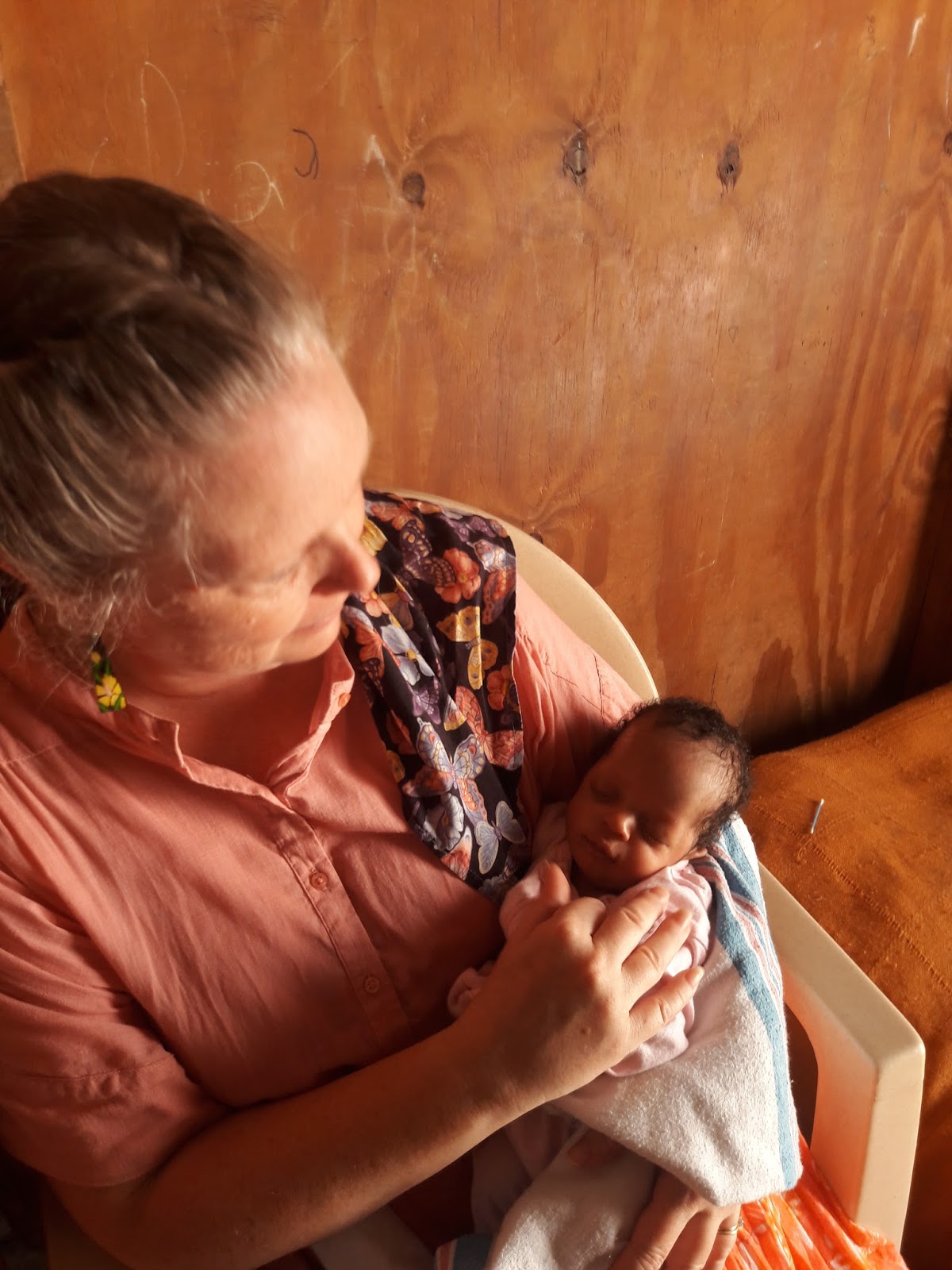
Wednesday, May 2, 2018

I Need Thee Ev'ry MOMENT: Step by Step


You’ll forgive me for not blogging more. You understand we are very busy. You’ll agree that you are, too. Perhaps you’ll agree that life is so fast you seem to blink away the days. And yet, here, at least, the days are so full we seem to live three days in one, all the while blinking it away.

Typically I get up at 6, when the sun is coming up. I fold aside the mosquito net that protects me after fan cuts off, and look out the window to see what colors the sun is painting.
Typically I trot downstairs with flashlight handy to get the coffee going in the stove-top percolator. Then I head up to the roof to spend some quiet time with God while the sun rises and the world stirs.
By 7:30 we’re supposed to be at school or at least on the way. The past week we’ve been departing about 6:45, but in our defense we’ve had guests. And a few days last week there were two nebulizer treatments to give at 7. Oh, and remember, all times are Haitian. Haitian 7:00 runs anywhere from 6:45 to 7:45.
Once at school, which involves the short commute around motos, venders, dogs, chickens, wheelbarrows, papadap vans, floods of students in multi-colored uniforms, half-dressed women toting water, bicycles, and speed bumps, there is the barrage of students. We ooze through the clinging hands and clutching bodies, everyone eager for hugs and greetings. Up the steps, down the hall, unlock the office, set down the day’s supplies, which include daily teaching materials and the rotating assortment of medicine, pencils, toilet paper, crackers, peanut butter, and student gifts. Then grab the flags and song packets and back down the hall for teacher devotion.
Inside the first grade classroom the staff gather, minus the security guard and custodian who stay outside to manage children. And we sing. Every day another teacher directs us to a song, English and French or Creole, we pray, we recite a scripture, English and French, and then greet one another with kisses and joy.
Then it’s time for the children.

School runs from 8 to 1 for the three younger grades, and 8 to 2 PM for the elementary grades. My own schedule starts second grade full class English at 9 Tuesday, Thursday, and Friday, heading to third grade at 10:30. I have a break from 11:30 to 12:30 which is usually filled with maintenance (filling water buckets or washing dishes), visiting other classes (particularly Preschool 1 with the three year olds), eating, doing office work (organizing, dispensing medicine, stapling torn books), and actually lesson-planning (which is what the break is intended for.) Last week that time included catching up with Beverly, who was in and out to the hospital, and checking in on our teenage visitor.

Today is Wednesday, so there was Bible assembly at 9. As Beverly is not here and Madame Rose arrived late, I directed opening assembly outside, partnered with Madame Alice, our second grade teacher. We sang, prayed, and saluted the Haitian and Christian flags. Then I stood at the doorway to each class to greet each child individually. This is always one of my favorite pastimes, beginning with the three year olds who compete as to who can respond “Good morning!” the loudest in their pipsqueak voices, to the third grade, many of whom are as tall as my chest already. Sandrina in kindergarten likes to say, “I am happy to see you, too!” whether I’ve said this or not, while tiny Marie Fine in first grade says, “Jesus loves you, too, Madame Rachelle!”
Once all students were in class, the troubled group and I prayed in the office. This group of second graders has been struggling with obedience and for the past several days begins the day by praying in the office for Jesus to change their hearts.
“We’re going to have a good day today, yes?” I asked them this morning. “No dezod? No misbehaving?”
They all agreed. We prayed. I hugged each one and told them to have a good day, then sent them on their way.
Two students had “bouton,” infected bumps, that needed antibiotic ointment. Ismael had a suspicious one on his ear that made me nervous. Yuck. Four year old Roodna had several on her scalp. Then our dear little Munley needed his treatment.
Last week Munley came to school with dreadful burns on his calves—a common injury from a moto muffler. Munley is three, extremely intelligent, somewhat stubborn, and irresistibly adorable. Like many Haitian children, he is nearly impervious to pain. He had to go to the hospital to have the burns scraped and treated, along with a burn on his toe. The latter has since become infected, and must be soaked in salt water each morning.
Madame Rose brought him in, put water in the tub, and Munley took off his sandal, scooted to the very edge of the bench and stuck his wee foot in the water. I bustled about organizing papers, sharpening pencils, and writing the week’s Bible vocabulary on a poster for 9:00 assembly. Once as I passed Munley grabbed my arm and pulled it to his face. I remembered just how tiny he is. A mere baby, expected to endure suffering in silence.
After the soak we wrapped his foot in gauze and Rose stuffed it back into his sandal. Munley watched this while continuing to calmly eat his crackers. He made no noise as his nerves surely screamed.

Munley went back to class with Rose and I shaking our heads after him. Assembly began at 9 with singing, the kindergarten to third grade classes filing in and arranging themselves on the floor of the Recreation Room. We sang “I’m in the Lord’s Army” and “Jesus Loves Me,” in English and Creole. Then Rose and I taught the vocabulary and lesson about Samson, who was deceived by someone he loved. In the midst of this our friends Emory, Mary, and Amos dropped by on their way to Port au Prince. Assembly wrapped up, students swarmed back to class, and I gathered up my things to begin second grade English. We are working hard on Stop, Think, Answer, and phonics. Critical thinking is not a regular part of Haitian curriculum, which relies almost solely upon rote memorization.
Class went passably well. I love them dearly, but second grade is a mess.
Third grade is practicing past tense and beginning creative writing. Today we talked about what we did yesterday, a holiday, and reviewed their homework. Their love of learning is obvious in their rapid ability to learn new concepts. Some of us practiced spelling with the game Sparkle while those who’d not done their homework copied sentences off the board. As usual, I dismissed students by name to wash their hands and collect lunch; some stayed to finish up their work. All were done by 11:40 and my “break” arrived.

Today my office duties included stapling torn books, administering fever medicine to a four year old, organizing English class papers for Rose, and neatening up the library, while eating peanut butter crackers. Oh, and of course I popped in to see the three year olds.

At 12:30 I collect a small group of third graders and we go to the library. This week we have been writing and drawing pictures about the books they brought home last week. Once a week these students can “check-out” books from our library by writing name and book title on a highly technical piece of lined paper. They each read to me and answer some questions. I send them back to class at 1 with a new book, and collect a larger, rowdier group of second graders. Last week and this week a day has been missed so I’ve put two groups together…and inevitably sent at least one student back to class for lack of cooperation. Small group is a privilege organized by ability level. Misbehavior revokes the privilege.

At 1:30 my schedule is finished. Usually that means at 1:40 the students are gone and I’m left alone in the library. Sometimes I stay to straighten up. Sometimes I set on the bench and lesson plan. Sometimes I head downstairs at once to do office work or check in with Beverly’s first grade English class, or just play with the kids outside. Those kindergarten and preschool students not yet picked up play outside in the courtyard and love to have company.

Today I went straight to first grade to assist Madame Rose and Madame Samanne who are running English class without Beverly. Beverly is gone to Texas for a bit following her mother’s death. We expect her back soon, but in the meantime do our best without her. Our school is certainly accustomed to doing without. Haiti is, too.

School ends for all at 2:00. There’s always a mad rush initially, and then students left awaiting parents or moto taxis. Today we had a tardy six. The taxi for four arrived at 2:35 and the taxi for two did not arrive. We left school with light rain at 2:50, piling the two leftover students and two intentional students into the backseat, Rose riding shotgun, and stopped for gas one block down. When we reached our street the taxi was waiting.
“Moto gen pwoblem,” the chauffer explained through the window as I stopped the car. “The moto has a problem. That’s why I was late. Exkise m’, sivouple.” Rose and I nodded our acceptance of his apology. We know this driver and he’s not usually a problem. Kingsaida and Marvens scooted out of the car, clambered onto the moto, and they were off.
That left the four of us to roll down the road, all pitted by the daily rain, and pull up to the gate. Saintilus hopped out to open it, as usual, and we got out of the car to the pleasant Ti Gôave afternoon sun and humidity. Always breathtaking.

We had electricity, an afternoon privilege courtesy of the soccer broadcast, so I got Adeline started on the nebulizer right away. Adeline is eight years old, diagnosed as severely asthmatic, and lives in an environment conducive to never improving. Generous folks donated nebulizers, and now Adeline can come home with us when she needs treatment, rather than waiting at the hospital.
After about 15 minutes, during which I kept prodding her awake with a stroke on her cheek, the medicine finished and we could eat. Rice and beans and fish. The table was quiet today without our guests, Beverly, or the house sons. Once we’d finished, I got my purse and Adeline her backpack and Alixthon, a cousin of Pastor’s with good English, joined us to go to the copy shop.
We collected our copies, paid the bill at 2 gourdes per sheet (63 gourdes to a U.S. dollar), and then dropped Adeline off at the house where her mama works. Rubbing my forehead for the nasty throbbing there, I drove us home, Alixthon directing me unnecessarily with exaggerated gestures.

At 4:15 we arrived home and I went upstairs. I got out of my beautiful, not incredibly comfortable uniform and fell down on my bed, sunburn itching back and shoulders. The fan was still on when I woke up groggy two hours later.

I don’t always take such luxurious naps after school. But I think I always need them. Now the sun is nearly set at 7:30 and I’ve done no preparation for school. I did collect my laundry off the roof, which I washed by hand yesterday afternoon before going to evening service at church. I do have the copies ready for English homework tomorrow and I am looking forward to hearing the kids’ progress. I refuse to think beyond that, for my heart is sad at Beverly’s absence and our guests’ departure. To consider a whole week without my other half, our amazing American director, her silliness, her joyful singing, her laugh, her hugs, our adventures, early morning and late night visits in her room—that is too much.

And so, as Rose and I agreed this morning, we simply go step by step, moment by moment if we must. The phrase “every hour I need you” falls short—every moment we rely on Jesus, every moment we ask for help. For the three year olds with infected burns and no one competent in basic first aid at home. For the kindergarten student who’s hungry but plagued by cavities and doesn’t want to eat, which may be just as well for Papa can’t afford to buy food. For the undiagnosed maladies, the unpaid debts, for all the mourning parents who don’t find their child’s name on the list of new students. Instead, we focus moment by moment, step by step.

Today is almost finished. I think it’s early to bed for me. So the next step is to fold that laundry and put it away. You’ll forgive me for not writing more. Some days it’s more than I can do to lesson plan and neaten my room. Whatever I do, may it be in love. Step by loving step.

“Lord, I come, I confess
Bowing here I find my rest
Without You I fall apart
You're the One that guides my heart

Chorus:
Lord, I need You, oh, I need You
Every hour I need You
My one defense, my righteousness
Oh God, how I need You

Where sin runs deep Your grace is more
Where grace is found is where You are
Where You are, Lord, I am free
Holiness is Christ in me
Chorus

So teach my song to rise to You
When temptation comes my way
When I cannot stand I'll fall on You
Jesus, You're my hope and stay” – Matt Maher “Lord, I Need You”


“1. I need thee ev’ry hour,
Most gracious Lord.
No tender voice like thine
Can peace afford.
Chorus: I need thee, oh, I need thee;
Ev’ry hour I need thee!
Oh, bless me now, my Savior;
I come to thee!
2. I need thee ev’ry hour;
Stay thou nearby.
Temptations lose their pow’r
When thou art nigh.
3. I need thee ev’ry hour,
In joy or pain.
Come quickly and abide,
Or life is vain.
4. I need thee ev’ry hour,
Most holy One.
Oh, make me thine indeed,
Thou blessed Son!” – Annie S. Hawks “I Need Thee Ev’ry Hour”


Friday, April 13, 2018

Nothing is Guaranteed


Yesterday I watched a little boy denied lunch. His name is Sheinder. He’s Haitian, very petite, and one of our students—three clues he likely doesn’t eat much at home. This midday meal of Feed My Starving Children Manna Pack Rice is probably the biggest, most nutritious meal of his day. He is accustomed to a heaping portion piled on his tin plate: a portion you might find ridiculously oversized for such a little boy. But he consumes it all. I’ve seen him return for second helpings.

Yesterday we ran out of food. Sometimes this happens, and it’s always heart-wrenching. The sound of the spoon scraping the bottom of the pot when there are still children with empty plates makes me cringe. Someone will be going hungry.

This year the second grade class is the last class to eat. The twenty-six come up from Recreation after washing their hands, and oft their sweaty faces, and make an unruly line in the kitchen to receive their lunch. All of our students know to ask for a large “gwo” or small “piti” or “ti kras” portion. Everyone is required to have at least a small helping of the rice and beans because of the nutritional value. Some students lament their minute spoonful as they favor their home-brought, store-bought snacks or treats, but generally everyone is obedient.

Then there are those like Sheinder, who come with tummies ready to be filled to bursting, so that the meal might carry them through the next twenty-four hours or so. Those like Sheinder, who live in shanty-like houses with sagging walls, tarp reinforcements, leaky tin roofs, and underfed family members.
These children are as hungry for food as they are for affection, for their desperate parents work dawn to dusk to provide for those hungry mouths. There is little time for tenderness.

At school we try to give love in all ways: from meeting those desperate felt needs of thirst, hunger, illness, and nakedness, to the more insidious ones of loneliness, doubt, neglect, and ignorance. But with our humble wonderful staff of 13, we cannot lavish enough attention on 144 hungry children.

We at least try to guarantee they are greeted by name, fed, and watered every day.

This week, I watched two of those things go unfulfilled.

Praise God, it was not the former.

This week electricity has been even more sparse than usual. We haven’t received power until at least 8:00 at night and lost it by 2:00 in the morning. These are sparse, dark hours, not hours to do repairs or run water pumps. Water pumps such as the one needed to fill the cistern that fills our school water barrels. Like many buildings, we have neither electricity nor running water at school. Unlike many school buildings, we are blessed with sound walls, floor, and roof. We do not fear the rain. We are blessed with two toilets for the students. We do not have to send our children outside to the latrine and they do not have to squat over drains or ditches. Praise the Lord.

However, these toilets are flushed manually by the waste water we collect from hand-washing. 144 students and 13 staff go through a lot of water every day washing their hands after using the restroom or before eating (which we require.) Thus the school runs through 2 55-gallon barrels of water every day for washing and flushing—and nearly an additional barrel’s worth to fill the 5-gallon drinking buckets in each of the six classrooms.
That’s a lot of water. (Although still significantly less than a school with running water would use for power-flush toilets, sinks, and water fountains.)

This week, the cistern that supplies that water went dry. There was no electricity during the day to run the pump that could fill the cistern. Monday and Tuesday we watched the water levels drop, told we needed to buy water, although we’d already paid the water bill for April.

“It’s not our problem,” Beverly said to Rose, director to director, as Rose relayed the news from our afternoon custodian in charge of filling the water barrels. “We paid for this month.”

“Yes,” Rose said, “but not their problem, too. No EDH, no pump. No water.” She wrung her hands emphatically in that Haitian way, as though absolving herself from guilt as Pilate tried to do.

No, it wasn’t the water business’ fault. The city had not given us power. It wasn’t really their fault, either. EDH is the national electric company Electricité d’Haïti, controlled from the capital. Everything came back to the government and their lack of organization, lack of infrastructure, lack of ability. Ayiti pwoblem. Haiti is a broken country tangled with problems; follow one thread of an issued and you will find yourself back to the Gordian knot at the center.

“So what do we do?” Beverly asked, as I relayed to her again the necessity of doing something. There was no extra water left in the school. There had again been no electricity. The cistern was still bare. The water we did have was swarming with mosquito larvae. We dumped bleach in the barrels in hopes of killing some off.

Rose shrugged. “Buy water,” Rose said. “Arold says he needs 100 gourdes.”

So we paid. Through the morning, and through this week, Arold toted in 5-gallon buckets of water from another source. He carried one on his head and another in his hand. This morning he came through with three in a wheelbarrow. The first time I refilled the hand washing bucket I thanked God to see water brimming the top of the barrel.

But two days ago the kids were thirsty. They are supposed to bring a water bottle to school, whether it be a thermos, canteen, or recycled Coke bottle; so they can drink water through the day. For every malady we tell the kids, and staff, to drink water. Haitians are dubious of water’s merits, but we are insistent.

Two days ago some of those kids who had faithfully brought their water bottles came to me. “Madame Rachelle, I want some water,” said some third and second graders.
Grimacing, I shrugged. “I don’t know,” I answered. I didn’t know where there was any water.
Sometimes when one class has emptied their bucket we send the kids in groups to another class to refill bottles—that day I was sure every class was dry.
And so we had to tell the kids our constant remedy of “drink water” was impossible: there is no water.

That morning my voice was nearly inaudible. I’d gone to bed with a stuffy head and awoken with a sore throat. As Beverly stood in the office, sweat running down her face (that’s normal for us), looking down at attendance to see which boys needed fungal cream for the irrepressible head fungus, and spooning cold medicine to runny-nosed kids, thinking about report cards on Friday, inscriptions of the incoming class, picking up our food allotment for the previous month, dwindling peanut butter and cracker supplies, teaching first grade English, returning to the house to file finances, contact partners, and return messages about her ailing mother and husband—as she stood there in her tight uniform with barely a breeze stirring the stuffy room (at approximately 80% humidity), Beverly was, as Rose, said, “not happy.”

I went to her and hugged her, pressing my own sweaty face close to hers, so she could hear my faint voice.
“It’s just there’s no water! Water is so basic! It should be guaranteed!” she said. Blessedly, usually it is for us.
“But this is Haiti,” I reminded her. “Nothing is guaranteed except Jesus.”
She managed a weak laugh. Me, too.

Better to laugh than cry.

And how true are those words. In Haiti perhaps they are more obvious, more visible in this broken place of pwoblem, pwoblem, pwoblem, of hungry children, parasites, sagging houses, sewage, unemployment, and instability. But in this whole world there is nothing to be sure of. Everything collapses.

This winter in New Hampshire we lost power for a time. A blessedly brief time, but for a while there was no electricity. That meant there was no running water, no light, no internet. For my parents, it did not signify no heat or cooking for they have a gas stove and wood stove. We stow water for emergencies and can set refrigerated food outside to keep in the frigid air.
But how inconvenient! Oh, how we love our electricity!
Another nor’easter dumped snow on us the morning my father suffered atrial fibrillation (AFib)—cardiac irregularity. He couldn’t snow-blow the driveway to clear out the 18 inches of snowfall so we could drive to the hospital. Oh, such helplessness!

This kind of desperation is how life in Haiti is much of the time for most of the people.
Beverly and I are not so deprived at the house where we stay, although many of you first-worlders are surprised at what we do without.
Life is undeniably sparse here.

This week, that sparse desperation touched us at school. In the lack of water so children were left thirsty in the high heat and humidity. In the lack of food as we ran out at the end of the second grade line so four boys were left with a fraction of their usual heaping portions. In the parents and guardians pushing for inscription forms to enroll their three-year old charge in the lottery for next year’s class: In one afternoon we received 86. The class can only take 25 students.

Such desperation, such suffering, can be overwhelming.
Sometimes it has knocked me down just to witness it.

This week, it did not.
Because I remembered what we are guaranteed: Jesus is with us. Through trial, temptation, through storm, through starvation, through persecution, imprisonment, through heat, humidity, and hunger. Through parasites, manifestations, darkness, and thirst. He is there with us.

He helped me to be strong for Sheinder.
So when Sheinder, this petite second grader, was denied his proper serving of lunch, I did not cry with him. He turned to the wall with a wail of objection, outcry at the injustice of seeing his twenty-two classmates walk away with their desired amount of food, small or large. He left his diminished plate untouched on the serving table.
Not only was his portion already undersized as our server, Madame Dada, scraped the bottom of the pot for rice to set on the three remaining plates, but it was then further reduced as she halved his portion to give some rice to the last student who had none.

The other boys accepted their plates and the crackers I pulled from the cabinet to supplement. They began to eat with gusto.
Sheinder turned to the wall, resting his forehead on the cement and looking at the floor.
He didn’t want crackers. He didn’t want to eat at all.
“W’ap manje?” I asked him. He shook his head.
His classmates reached for his plate to divide it among themselves. I shook my head.
“No. Leave it for Sheinder.”
Then I picked up the plate myself and led him from the room. I took us down to the office and sat Sheinder on the bench beside me.
For the next five minutes I just held him.

I didn’t have words for him, but that didn’t matter. I held him and rocked him, kissed his forehead and let the love flow into him.

Then I straightened up.
“Ou pral manje?” I asked. He nodded. He would eat.
From my backpack I took a granola bar and added it to his plate. From the table I took a lollipop another student had given me and put it in his pocket for later.
Then I handed him the plate and let him eat.

Sheinder was solemn the rest of the day. But he ate. And he felt love.
Love conquers that desperation. That sparseness.

This afternoon, as I worked in the office, Sheinder trooped in with an enormous heaping portion of rice and beans on his tin plate.
“Wow, Sheinder! Are you hungry?” I asked.
“Yes,” he said, beaming.
“Are you happy?”
“Yes,” he said again, nodding.
“Hooray!” I said, hugging him. We went up to the kitchen together, and four other boys held up their own heaping plates for me to see. Madame Dada grinned at me.
“We have food!” I said. “Thank you, Jesus!”

And that Name is the only guarantee we have in this life.  

 "Surely I am with you always, to the very end of the age." - Jesus (Matthew 28:20 NIV)


Sunday, February 11, 2018

After the Visit: Reflections by Rebecca, Part II

The following was written by Madame Rebecca, who visited CAP February 2017 and November 2017 for a total of seven school days. An educator from NH, Mdm. Rebecca wrote these pages of reflection after her return to the U.S.

Part II
Christian Academy of Petit Goave, Haiti
Mission Statement 
Christian Academy of Petit Goave seeks the Lord's guidance to educate impoverished children in Biblical knowledge, life skills, and relationship building to create a rich school environment, supportive families, and unified community. 
Education:
To understand education in Haiti, it is necessary to recall what schools were like in America decades, or even centuries ago.  The methods of rote learning and recitation are reminiscent of late 19th and early 20th centuries.  A more accurate analogy might be what was fondly known as a ‘blab’ school in Colonial America.  A small group of children, under a school master or school ‘marm’ all recited their different lessons out loud at the same time.  Imagine the cacophony!  Then imagine a concrete building with 145 students all competing for a voice at the same time: now you can begin to appreciate Haitian schooling.
The spoken language of the Haitian people is Kreyol (Creole).  This owes it origins to the time before Haiti won its independence from France.  Initially a mix of French and African dialects, Creole was the language of the slaves, then of the populace which won its freedom.  This is the language that all Haitians learn at home.   Most books, including the simplest primers, are written and published in French, the language of education.  Most schools begin introducing English in the early grades.  For a student to complete their course of studies they must complete their equivalent of our high school, including two standardized, substantial government exams.  The percentage of students who finish is very small.  Earlier generations of parents, grandparents, etc. benefited from little schooling, and many are illiterate.  Parents universally desire something better for their children, and education is greatly valued.  Education is one answer to Haiti’s major issues.  If you are fortunate enough to complete the final government exams, (and many study and take these tests repeatedly), there are opportunities to attend university.  Some universities begin the higher level courses immediately, because if you have mastered the earlier exams, these are comparable to our first two years of college.  Higher education, equivalent to a graduate degree is very difficult to come by within the country, and usually students must go abroad to further their training.
At the school in Petit Goave, children begin at age three, (or turn three during the year).  This is typical of many Haitian schools.  Unlike preschool programs here, the children wear uniforms, sit in chairs or on benches, and write with pencils and recite information.  Play is unknown.  From a young age children are conflicted with the opposite pulls of conformity to rules and teacher direction, and the need to stand out and receive attention and recognition.  Misbehavior is not tolerated in Haitian schools, punishment is generally swift and severe, and can result in permanent expulsion.  But yelling louder than anyone else, and striving to be the best and first is reflected in the pervasive competitive spirit.  At least in the school in Ti Goave, the children are not quiet, despite the teachers’ constant call for silence.  When a child knows the answer, or wants to be acknowledged, they raise their hands, wave their hands, or leap out of their seats.  They also verbally yell out “Me!  Me!” or they yell the answer itself; another disturbing manifestation of noise.
Many public schools in Haiti are held under roofed structures, with or without walls, with dirt floors.  Others are of concrete construction, but are small, dark, and with no amenities.  Private schools abound, some cater to the few wealthier familiesand have electricity, running water, and some technology resources; but many mimic the primitive public schools.  Some private schools are funded by non-governmental organizations (NGOs), receiving donations of money, materials, and services from the United States and other nations.  Teachers at many of the schools have received some training, but not a lot.  They teach in the same style they were taught, and are resistant to change.  Sometimes teachers are hired who have not completed their government exams, but they are considered to have enough education to be able to teach others.  Training on subjects like classroom management, using materials, dealing with social or emotional issues are not available.  Teaching the basics for reading and mathematics is occasionally supplemented with writing (grammar), languages, and some science and history, but extracurricular activities, the arts, and even physical activity are unknown.
 Everything is memorized by rote repetition and study, and students are examined orally or on paper only to assess whether or not the concept has been memorized, not understood or reasoned.  Second graders may be able to recite addition facts, but they don’t know that they have ten fingers and that constancy of numbers doesn’t change.  Preschool students learn to recite the alphabet in three languages, but don’t necessarily know the sound the letters make, or how to put them together.  They learn to rote spell, but don’t apply it in their writing in French or in English.  (The constant need to switch languages does not help master concepts.) 
In most schools students are punished for not ‘knowing’ their lessons.  This includes public shaming, and corporal punishment.  Over time if a child cannot keep up with the curriculum they may receive poor grades, may be retained another year, and if they don’t show improvement in their progress, they are ultimately no longer welcome to attend school.  Remember that all students have to pay for their education and because schools are desperate for money and resources, they accept more students than they can accommodate, and so if children fade in and out of a class, no one really follows through.  Any student who cannot access the curriculum in the one size fits all style of teaching is simply ignored or passed over.  They are labeled as those ‘without intelligence’, and it is not possible to extend the effort to really reach these who ‘cannot learn’.
I am happy to report that the Mission school in Petit Goave differs from the typical model in several important ways.  The school is funded privately by donations from people in the United States; this includes the rent for the building, paying the salaries for the teachers, providing the books and uniforms for the students, the enriched rice and bean lunch, basic health care, and many donated supplies.  Each spring parents come in to register their soon to be three year olds for the incoming class in September.  Last February over one hundred applications were filled out over a two day period.  Only 25 slots were available so more than 20 of the students were chosen by drawing names in a lottery system.  Many heartbroken parents pleaded for the director to reconsider, citing such valid reasons as already having a sibling in the school, or having no other avenue to pursue for their child’s education.  In other schools they may have accepted a larger number of students, but part of the philosophy of this school is that it is not feasible or desirable to have a class with one teacher and more than 30 students.

Some of the children accepted are invited deliberately because their unique conditions are known to the staff.  These students are some who would never have an opportunity to attend a typical Haitian school.  They are children with low cognition, with health problems, or other challenging needs that just simply could not be addressed in another environment.  These students, including a girl with Down syndrome, another girl with severe asthma, a little boy who doesn’t speak, by no means receive the services they deserve, because the resources don’t exist.  However, the miraculous fact that they are allowed to attend at all speaks well of this special school.
There is no corporal punishment at Christian Academy.  Children are not punished for not knowing their lessons.  As much as possible the teachers try to reteach and allow another opportunity to try.  A child who is significantly behind academically is retained in the same class for a second year.  Currently there are a few students who have been retained but are not making the necessary gains.  It is unknown at this time what will happen with them next year.  (It is common for much older students to be found in primary classes, because when they were younger they had no opportunity for school, but now have a chance.  The young man who serves as the custodian in the mornings, goes to fourth grade in the afternoons.  He is 17.)
Misbehavior is treatedwith a different philosophy as well.  Children are sent to the office where an administrator speaks with each of them individually.  Often the children are asked to copy lines such as:  ‘I will obey my teacher.’ Or ‘I will be respectful during assembly.’  Frequent offenders or more serious infractions include parent contact, and possibly a conference.  Depending on the situation the director may recommend that the parents administer some form of corporal punishment. The philosophy is that sometimes a child needs this type of correction, but it must be done appropriately, in love, and in the child’s best interest.  Part of the process at the school is to remind students not only what the teacher and school expectations are, but also what God desires for them to do and be.  It is constantly reiterated that the children are loved and that the staff desires them to be there and wants them to grow and learn.  It is also understood that if a child or a family is unable or unwilling to change, other students are waiting for the chance to come to school.
School Motto: recited weekly

Discipline: students are copying the School Motto in the office


There are many disturbing issues about the school, and it is hard to reconcile an American mindset with the real world problems in Haiti.  I was told that the three and four year olds don’t know how to play.  The three year olds have a few toys in their classroom, and have a small amount of time scheduled in their day to use these materials at their seats.  The four and five year olds do not have toys or playtime.  While there I went into the three and four year old classes a few times with a small bag of toys, and passed out one item to each child.  What I observed was typical of what you would see with babies and toddlers here.  The children were eager to receive a toy, but they banged it, or they took two and banged them together.  They also grabbed the toys the other children had, because of course, the grass is always greener.  After a while they figured out how to drive the little cars along the table, and even to speed them off the table.  I modeled how to roll the balls to each other, make the little plastic animals walk and hop, and cradled the baby dolls and stuffed animals.  But after a very short time I had to remove the toys because their exuberance was overwhelming and they quickly became over stimulated.  Truly, they do not know how to play.

Reading The Twelves Days of Christmas to first grade

Many teaching materials have been donated, which would be valuable for providing concrete learning of concepts, especially in math.  The teachers have no experience with these items and have not yet been shown how to use them, so they are currently sitting in a locked room on the second floor of the school.  Teachers need to be trained and given opportunity to utilize the simplest tools, so that they in turn can teach the children.  The director shared my frustration in not being able to introduce the items, but she also respects that the wheels of change turn very slowly, and staff need to be given time to adjust their mindsets.
One particularly disturbing thing is that children are not being taught to think.  They do not reason or problem- solve, or apply or discover or explain anything.  (Except perhaps to try and justify the reasons for their bad behavior.)  Haiti has a history written in blood and poverty, exploitation, military occupation, and debt.  The once beautiful Pearl of the Caribbean has been deforested and stripped of its natural resources.  Natural disasters like the yearly hurricane season, and the devastating earthquake of 2010 perpetually leave them reeling.  Aid pours into the country but corruption and mismanagement prevail and goods and services fail to reach those who need them.  Malaria, and other mosquito borne illnesses, typhoid, cholera, severe anemia and malnutrition plague the nation.  Promises of better government services dissolve until the next white knight appears on the horizon.    Desperate people commit desperate acts, and the streets resound with manifestations and violence.  Children, the future adults, must learn how to reason and assess things critically.  They need the hope that education provides, but they need a better education, a different from that they are currently receiving.  Facts can be memorized, and everyone can acquire some level of speaking in multiple languages, but unless they learn how to apply principles, and utilize talent, unless they are given opportunity to rise above the teeming masses of humanity, they will not succeed as a nation.  Competition is fierce and only the best and brightest, or most assertive or persistent survive.
Having said all this, and it is unquestionably true on many levels, one cannot ignore the profound hope and joy that the people possess.  For anyone who lives in a ‘first world’ country, it is almost impossible to comprehend the ability to maintain ‘optimism’ and to endeavor to work hard even when there is little or no monetary reward.  How do they not give in to hopelessness and despair?  But, many Haitians will tell you that there is much reason to hope.  “Gen espwa anpil.”  For some it is the hope of education, it is the dream and desire that Haiti can regain the beauty and prosperity she once experienced.  The majority of people want to be engaged in labor and feel productive.  They take pride in their accomplishments, even when those accomplishments may seem small and even insignificant to us.  Some still put their hope in local and national government.  They are appreciative of all the aid that has poured into their country, and recognize that without international help, Haiti would not have even the minimal amenities they have; while at the same time they desire Haiti to function as an independent nation directed by its own people.  But one must look beyond these surface reasons, and indeed many are fully ready to ‘give an answer to the hope that lies within’.  To them it is not a mystery, to them it is obvious:  Jesus.
Living in such incomprehensible poverty, doing without so many things we take for granted, they are truly grateful for the very breath that sustains them, for their daily bread.  In a culture where starvation is a reality, the threat of malnutrition a constant companion, and anemia the norm, they are thankful for the daily meal of rice and beans.  Monotonous?  Yes!  But able to sustain life, yes.  Though there are physical hands that prepare the food, and a physical locality where the food is stored, and real people who donate their funds and resources to provide it, the impetus, the driving force behind the generosity is a benevolent God.  God is the one who places the desire to help on the hearts of those who are able to help.  God is the One Who gives and preserves life.  Over and over the people are willing to share their miraculous stories, of how God has provided.
How does this impact the educational aspect?  Every person who comes into the building is greeted with the words “Jezi renmen ou.”  (Jesus loves you.)  Every person is also greeted with the words “I love you.”  The staff is composed of normal people.  They are not super spiritual, they don’t have misperceptions of reality, and they don’t always feel loving and kind every single moment.  Every person instead recognizes that life is hard, but God is good.  They recognize that on their own they do not have the ability to love and care for one another.  Everything is dependent upon the God they serve, upon the Savior Who first loved them, and Who left the glory and splendor and riches of heaven, and Who lived in poverty, and died to redeem mankind from the broken fallen world of sin.  Every morning, before the children are formally greeted in the courtyard the staff meets to share songs of praise, verses of Scripture, and prayer for the needs of the school and their individual families.  Then each teacher greets every other teacher with a hug and kiss and words of affirmation and faith.
The Christian Academy of Petit Goave wants to educate children in fundamental academics.  They want to nourish little bodies, ensuring that they have food, clean water and basic medical care.  They want to encourage families, and model how to nurture and care for the children.  They want to show children how to get along and be kind; to be responsible and hard working.  But most of all they want to share the love of Jesus, and to imbue in every child the truth that their hope, their only hope lies in the Person of Christ.  Teaching reading and math, and doling out vitamins and cold medicine are important.  Holding students accountable for their actions is vital.  Preparing them for a future of higher education or trade is laying a firm foundation.  But the ultimate goal, the ‘mission’ is to share the love of Jesus.

What Can We Offer?  What Can We Emulate?
What can we offer?  Haiti needs goods and supplies.  The schools need materials, and the teachers need mentoring and training to utilize the donated items.  They need encouragement to continue on the incredibly arduous task they have undertaken.  The staff and the children are uplifted when teams and individuals make personal sacrifices to come and spend time at the school.  Students need people to partner with them and commit to monthly support, not only for monetary needs, but for emotional support.  The idea that someone who lives far away has purposed to set aside resources to benefit and love them as unique and special, is a gift that can never be matched.  In many aspects of education Haiti needs to be brought into the 20th century, then the 21st.  Creating a truly free public system for every student is the goal, but it is light years away.  Providing a place where every child can come and be cared for and trained in the most fundamental academics is a first step.  Teachers need to be assured that they will be compensated for their job.  Most of the teachers have families to care for, and they sacrifice many hours to teach other peoples’ children.  They do this for an incredibly small amount of money.  One primary teacher we met earns the equivalent of $35.00 American a month.  The public educators periodically go on strike because they do not receive any wages from the government for weeks or even months at a time.  High school age students hold manifestations in the street to protest the absence of their professors.  The professors strike, because they have not been paid.  These are mountainous issues which people from outside the country, no matter how well meaning, simply cannot fix.  Our challenge is to look at the smaller, more manageable pieces where we can make a difference.
What can we emulate?
At the Christian Academy of Petit Goave teachers set aside time every morning to meet together and encourage one another.  They recognize that in order to serve others, they need to make sure that they are renewed and refreshed every day.  They value each other and they value every child who comes through the door.  This is a lesson I think we can benefit from.  Of course we do not all share the same philosophies and world views.  Our schools are larger with many more staff and children.  Our problems are different.  Somehow though, I would like to think that it is always possible to encourage one another more consistently, and to show empathy and compassion to each other and to our students and their families.  Yes, there are days when this is very hard and we don’t feel like doing it.  For me personally I want to be reminded of the unimaginable obstacles that are normal for those living in Haiti.  Surely if they can persevere and remain positive, I should be able to do that.  I should not become so easily discouraged in well doing, and not complain about the frustrating circumstances I face.  If nothing else, I need to recall to mind the hope, the dignity, and the honorable choices displayed by the staff at this special school.  They are truly an inspiration.
Going to the Library with Third Grade


A very big Thank You and Merci Beaucoup, Mesi Anpil to Mister David and Madame Rebecca for their hard work on the ground at CAP, and their ceaseless energetic support of CAP and Beverly and Rachelle. Thank you for sharing your words and wisdom with us here on Ramblings, Mom. 

After the Visit: Reflections by Rebecca, Part I


The following was written by Madame Rebecca, who visited CAP February 2017 and November 2017 for a total of seven school days. An educator from NH, Mdm. Rebecca wrote these pages of reflection after her return to the U.S.

Part I
Christian Academy of Petit Goave, Haiti
Mission Statement 
Christian Academy of Petit Goave seeks the Lord's guidance to educate impoverished children in Biblical knowledge, life skills, and relationship building to create a rich school environment, supportive families, and unified community.

Physical features of the building:
  The National Road which connects Port-au-Prince with the western portion of the island passes in front of the building.  There is just enough space to pull in the vehicle from the house to park close to the metal gate manned by the hired guard.  (Unlike many places in Haiti, he is not armed with an automatic weapon.  Tall cement walls, topped with barbed wire and broken glass encircle the building.  The gate opens onto a small dirt floored courtyard, littered with building materials on the side.  There is just enough space for the six classes to line up side by side facing the building.  An exterior staircase ascends to a portion of the second story which is rented by a training clinic for nurses.  The children gather in the courtyard and wait for the teachers to be ready to sing and pledge to the flag and begin the day.
As they step over the high threshold, children proceed into the concrete building to their classrooms.  A bench sits along the left wall and it is here that children gather for triage, or if they have been pulled out of line for disciplinary action.  Along the left side of the corridor are four rooms.  The first two, grade one and kindergarten have been painted and contained louvered cement block windows.  Banana trees grow right up to the building and block most of the light.  The building has no electricity.  First graders have desks and benches which seat three to four students each, and kindergarten has long tables and individual low chairs.  Each room has a chalkboard, a bookshelf, a small table on which rests the water supply, and a table and chair for the teacher.  Each room has two doorways, with no doors.  The second two rooms are for grade three and recreation and were not painted until this January.    The recreation/assembly room is empty except for one small bench. 
On the right side are two rooms for the three and four year olds.  Each has a plywood door which can close.  The furniture is the same as for kindergarten.  The rooms are smaller, but brighter because of the natural light.  In the three year old room there is a basket with a few toys.  A small office, with a private toilet for staff, has a door which locks.  Records, medical supplies, and extra consumable supplies are in this room.  It is used for medical treatment, and discipline.  Following down to the end of the dark corridor is a two stall bathroom for students.  Outside is a table with room temperature water for hand washing, and strong soap.  There is no way to dry hands.  A large barrel of water sits at the bottom of the indoor staircase.  Jonas, the day custodian periodically uses the bucket from under the hand washing station to force flush the toilets, then refills the washing bucket.
Going up the cement stairs, which turn once, you ascend to the portion of the second floor which the school also rents.  Here is a small kitchen, with a counter for the two tubs of water for washing and rinsing the tin plates and spoons.  A table is for the pots of rice and beans which are cooked at the house and then transported to the school to begin serving at 10:00 am.  Earlier in the morning Jonas prepares peanut butter crackers and takes a plate to each class for a snack.  Another large barrel is used for filling the wash basins.  Detergent goes in the wash water and bleach is added to the rinse water.
The second grade classroom is located on this floor and though the furnishings are the same as first and second grade, this room receives more light and in addition to paint on the walls, they have also been stenciled in a bright design.  One small locked room contains shelves of donated books and some resources for teaching which are not yet in use.
Everything is constructed from concrete and there is nothing to absorb the sound.  Only the three and four year old classrooms have doors.  The Haitian style of teaching is rote repetition in loud voices.  The noise is relentless and inescapable.  The room used for recreation allows each class to come in for some physical activity while they practice academics and English.  Here is the only time the children get to run around (a dark concrete room), and the noise level is commensurate.  Additionally is the constant noise from the flow of traffic and pedestrians outside the gate.
There is only natural illumination, and recently a couple of rechargeable battery operated lanterns for the darkest rooms (kindergarten and third) to augment the limited light.  The property next door is owned by someone else so the landlord cannot cut down the vegetation blocking the light.  The green chalkboards are almost impossible to read from the back of the classroom.  The children write with pencil on tiny lined notebooks that absorb the humidity, and even the graphite is hard to decipher.  Obviously, there are no technological devices of any kind.
If you stand in the hall you may be fortunate enough to catch a breeze coming from the courtyard, but there is no ventilation anywhere else.  Even in November, it is hot and humid.  Many bodies in small spaces raise the temperature.  Here is one reason to be thankful for the concrete.  School begins at 8:30 a.m.  Three, four, and five year olds are dismissed at one and the older students at two.  By the afternoon everyone is wilting in the heat.
As the day progresses the stench from the bathrooms (two toilets for 145 students) becomes unbearable.  It is necessary to hold your breath when you go up the stairs.  By 9:30 the floor is soaked with water from hand washing and force flushing. The children and staff walk through it all day, adding mud to the concrete floors.  A night custodian comes daily to clean.
Many schools in Haiti are simple roofed structures with open wall, which is why school is cancelled nearly every time it rains.  Nicer, expensive private schools have more amenities.  Most schools require uniforms and books, which parents must pay for. 

Health:
Children receive peanut butter crackers in the morning and fortified rice and beans (Manna packs from Feed My Starving Children) for lunch.  (Extra nutrients have been added, and occasionally the person cooking adds a few canned vegetables.)  Children and are given oral vitamins with iron daily.  Children and staff are given worm medicine every six months.  Some children do eat something at home before they come, many do not.  Some bring pre-packaged snacks from the vendors which line the streets, most do not.
In each classroom is a double bucket with lid.  Water is poured into the top bucket which contains a charcoal filter.  Water flows into the bottom bucket with a spigot for filling water bottles.  Each child has been given a water bottle, but a supply of pre-used juice bottles is kept in the office when they need a replacement.  The children are encouraged to drink water frequently, as their supply at home may not be as sanitary and it is a hot climate where much body fluid is lost through perspiration.
The vast majority of the children come to school scrubbed clean.  They wear their uniforms Monday through Thursday, and are allowed to wear other clothing on Friday.  The uniforms may or may not get washed during the week.  The school ensures that children are provided with clean socks and shoes if they do not have them.  In a culture where almost everything is outside of one’s control, they take pride in their personal appearance.  (I was astonished to see little girls coming on Friday in spotless frilly dresses. (Lye soap and sunshine is the key.)  Of course some children come disheveled, and uncared for, but the majority is more than presentable.
In the morning when the children enter school, any who are sick wait on the bench to be summoned to the office.  This may involve a teaspoon of cold medicine, a dose of acetaminophen, cream for head fungus or ring worm, or wound care.  Serious illnesses are taken by the director to the local hospital, where you pay up front before any treatment is given.
When I visited in February, many children were suffering from grippe(cold symptoms).  I was given a bottle of cold medicine and a handful of metal spoons.  Depending on the age and weight of the child I dispensed liquid accordingly.  When finished each child took the used spoon to the kitchen to be washed in bleach water.  During the November trip I was much busier with medical concerns.  Many of the little boys suffer from head fungus.  They wear their hair very short, or completely shaved.  The boys line up and with one gloved hand for all of them, ointment is applied to each spot.  One child had a severe case and was taken to the hospital.  Infection was discovered and he was given an antibiotic.  Unfortunately he took it at home on an empty stomach the next day and vomited it all over the floor of the office at school.  (The good thing about it was that the office is the only room with a tile floor which makes cleaning much easier.)  The several cases of ring worm were treated with the same topical ointment.
On different days I had little girls coming to school with very high temperatures.  (102 and 103)  These I treated with acetaminophen, and sent back to class.  One girl, who was too ill to return to her studies, stayed in the office, lying on the hard wooden bench.  I sponged her down with water, and she eventually went to the hospital because we learned from her mother, who is on staff, that she had not been eating.
Any child taken to the hospital is tested for parasites (requiring a stool sample), anemia (because they have virtually no iron in their diet) and are given vitamin C.  After those things are checked, they look at the symptoms.  The child with the fever and the boy with the severe head fungus were both found to have intestinal parasites, though everyone was dosed with worm medicine in October.  The little girl who had not been eating was prescribed vitamin C and an appetite stimulant.  None of the three students were anemic enough to warrant attention.
Wound care is another ongoing task.  The normal bumps and bruises of children are virtually ignored in Haiti; they are simply not serious enough to deserve notice.  More serious wounds from cuts, scrapes, or burns are tended to.  (Because most of the children live in hazardous environments, and because many of them travel to school on motos, (motorcycles with long seats that carry a driver and up to five students) and because everyone cooks over charcoal fires, wounds are common.  One boy had a partially healed burn on his leg which I washed, treated and bandaged.  The wound had begun to close without getting rid of the inner infection, it had not been stitched and the scar will be significant.  He was taken to the hospital and the director was at first told that he would receive a surgical procedure.  Though the wound should have been opened and drained, it was just washed and covered with a single band-aid.  His treatment at school was better.  This child barely flinched while I was treating his leg; many children in Haiti have learned to tolerate pain because so little medical attention is available.  Another boy, however, reacted as most seven year olds would.  His wound had scabbed over and then was scraped off.  I cleaned and bandaged it, while he cried, but the second day it was full of green pus.  He was afraid to have me treat it again, but the director chided him for his understandable reaction.  The children have to learn to be tough!  Fortunately on my last day there, the leg was looking better.
I visited a local pharmacy while there.  It is a typical, tiny store.  You step in and immediately in front of you is a long counter, glassed in, with a window to pass things through.  On display behind glass is over the counter remedies, and the pharmacist hands everything from the inventory in the back.  I don’t know what happens if the medicine is not in stock.  One day we went to fill prescriptions for a sick baby we had visited.  The mother had taken the baby to the hospital where it was evaluated, but the family did not have money to pay for medicine.  The doctor wanted it treated with acetaminophen for fever.  The house and the school have a donated quantity of this, but not the infant dose, so we purchased this.  The hospital recommended pedialyte for the dehydration and diarrhea, but this electrolyte isn’t available in the town.  It can be purchased in Port-au-Prince, but it is very expensive.  We bought Gatorade to give to the baby.  We did fill a prescription for an antibiotic.

Mdm Rebecca with one of the triplets

Recording height and weight of four year old students

Another family we visited has one month old triplets!  The previous week the family asked for assistance because the babies were losing weight.  Through connections the director was able to procure cases of free formula to supplement the mother’s breast milk.  Another connection in a close town will be providing care and supplemental food and nutrition for the mother and the babies every other week.  The director will pick them up and transport them.
Students at the school each have enrollment information, a copy of their birth certificate, and any medical history available.  Copies of height and weight growth curves are also in their files.  While at the school, my husband and I weighed and measured each child and I recorded and plotted this in their chart.  The three year olds did not know what to make of the process, and needed lots of help and encouragement to complete these ‘scary’ requirements.  Most of the rest of the children have experienced this before and I was happy to see that only gains had been made.  One little six year old who has a history of severe malnutrition, has now made it onto the curve!  This was a reason to rejoice.  Tracking height and weight are not common in Haitian schools.  Hearing and vision checks are unknown.
As previously noted, there are two toilets to service 145 students.  Many of the children have never used a toilet before entering school, and need to be taught how.  There are two stalls, and a privacy wall, but no doors.  Toilet paper is kept in the office, and children must stop by and help themselves to a few sheets when needed.  Afterward they wash from the room temperature water and use the round, rough soap.  Hands are air dried or wiped on their uniform.  The office toilet paper is also used for runny noses.  Extra rolls are locked in the supply cabinet in the office.  To my knowledge there is only one student who is not ‘potty trained’.  She is not yet two years old who is there because her mother is a teacher.  Despite the lack of sanitation facilities in the home, or perhaps because of this, children seem to learn to take care of this bodily function very early.
Tin plates and spoons are used and washed and reused several times to service all the children for lunch.  All children are required to take a small serving of rice and beans, even if they have brought something from home.  Some children request a large portion, because they are very hungry and may not eat again until the next day.  Weekends, and other days off from school are very chancy.  There are no government services to help.  Extended families and neighbors care for each other as best they can.  In extreme cases, families go to visit the Pastor’s house to request food, or express other needs.
Each class spends a half an hour in ‘recreation’ moving around, and practicing academics in the one open room in the school.  This is another unknown for Haiti.  Children sit or stand in silence and follow the directions of the adult, or they are disciplined.  Continuance discipline problems result in permanent expulsion.  Though the school doesn’t have any place for children to run around or play outside, they know that physical activity is important, and under the influence of the American staff, have worked this into their day.  The guard doubles as physical education teacher for the three year olds, (also known as herding cats).  A young university student comes four days a week to do recreation for the other grades.  The day he doesn’t come, the guard covers all the classes.
Recreation is held in the unfinished concrete room.  This room is also used for assemblies.  It is a small, dark, echoing space, and falls result in bumps and scrapes, but this is a small price to pay for the opportunity to act like children!  The school is grateful for this space and utilizes it to capacity.